Two of the most capable image models on the hiapi platform — GPT Image 2 and Nano Banana 2 — get compared a lot. The marketing claims are similar: state-of-the-art text rendering, photorealism, complex composition. The price is not: GPT Image 2 costs $0.03 per image at 1K resolution, Nano Banana 2 costs $0.036 — $0.006 more per image, or 20% higher at regular rates.
So which one should you actually use? We ran the same six prompts through both models, with identical size hints, on the same day. The results were surprising in a few places — and the cost-quality tradeoff is more nuanced than the price gap suggests.
How We Tested
Six prompts, designed to stress different capabilities:
- English magazine headline — text rendering on a clean editorial poster
- CJK calligraphy — Chinese tea-ceremony poster with vertical 楷书 brushwork
- Photorealistic product shot — artisanal soy candle with a brand label
- Complex multi-element scene — Mediterranean coastal village at golden hour
- Editorial portrait — half-body portrait of an architect in her studio
- Text-dense UI mockup — meditation app home screen with seven discrete text strings
Each prompt was run once on each model through hiapi's standard Chat Completions endpoint, with a requested size hint matching the intent of the brief (3:2 landscape, 2:3 portrait, or 9:16). The model defaults were left alone otherwise.
You can see all six head-to-head results below.
Test 1: English Magazine Headline
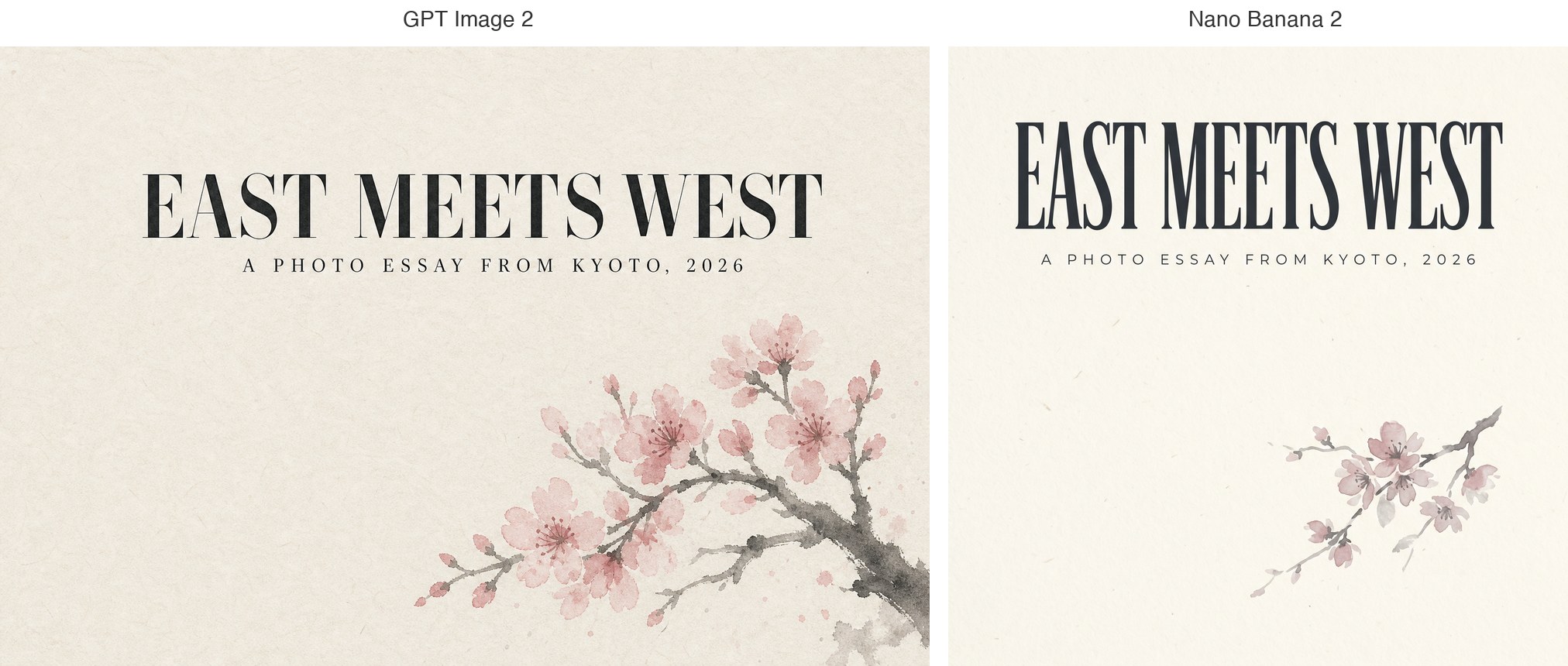
The prompt asked for a magazine cover with the bold serif headline EAST MEETS WEST, subtitle A PHOTO ESSAY FROM KYOTO, 2026, and a watercolor cherry blossom branch in the lower-right corner.
Both models nailed the typography — letters are crisp, the kerning is even, the subtitle is rendered correctly in small caps. Nano Banana 2's letter forms are arguably more refined: the weight balance reads as a designer-set typeface rather than a generated approximation.
But GPT Image 2 honored the 3:2 landscape aspect ratio the prompt asked for. Nano Banana 2 returned a square. For a poster — where the format is part of the design — this is a meaningful difference. The square crop forced the cherry blossom into a smaller corner and tightened the negative space.
Verdict: Nano Banana 2 wins on letter craft. GPT Image 2 wins on layout fidelity. For editorial typography work, GPT Image 2's reliability on format is more important than Nano Banana 2's marginal letter refinement.
Test 2: CJK Calligraphy Poster
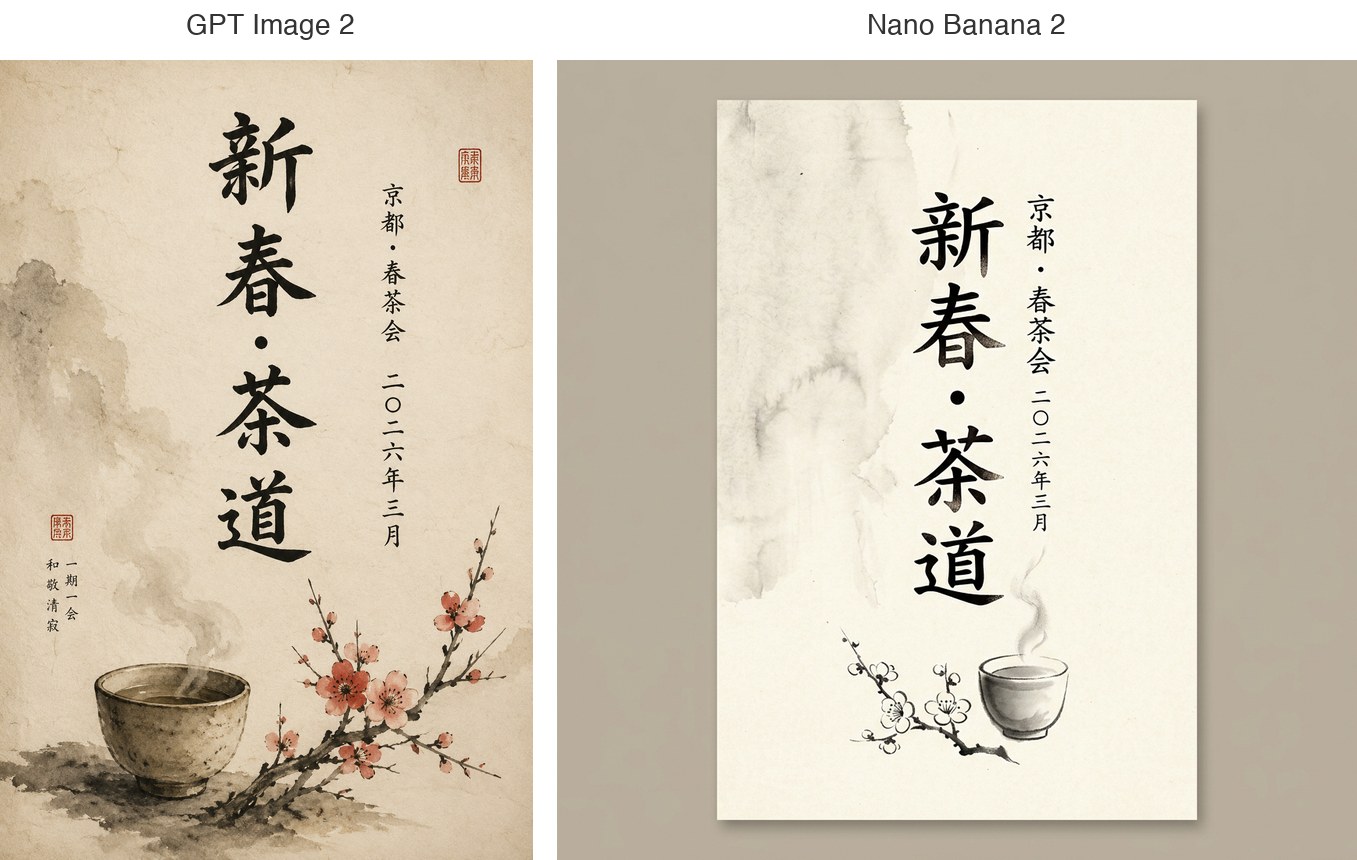
The prompt: a vertical Chinese-style poster with the title 「新春・茶道」 (New Spring · Tea Ceremony) in large 楷书 calligraphy and a smaller subtitle 「京都・春茶会 二〇二六年三月」 in the same script.
Both models rendered every character correctly. This is genuinely impressive — CJK calligraphy at this scale is where most image models still fail, and both passed.
GPT Image 2 went further: it added two extra phrases in small calligraphy at the bottom of the poster, 「一期一会」 (ichi-go ichi-e — "one time, one meeting") and 「和敬清寂」 (wa-kei-sei-jaku — "harmony, respect, purity, tranquility"). Both are real, well-known Japanese tea-ceremony idioms. They weren't in the prompt — the model added them because they fit the cultural context. It also included a steaming teacup, a plum-blossom sprig, and a vermilion seal stamp.
Nano Banana 2's interpretation is cleaner and more minimalist — just the title, subtitle, a small teacup, and a plum branch. Still beautiful, but less ambitious.
Aspect ratio: GPT Image 2 honored the 2:3 portrait request. Nano Banana 2, again, returned a near-square.
Verdict: GPT Image 2 wins clearly on this one. Better cultural depth, better format compliance.
Test 3: Photorealistic Product Photography
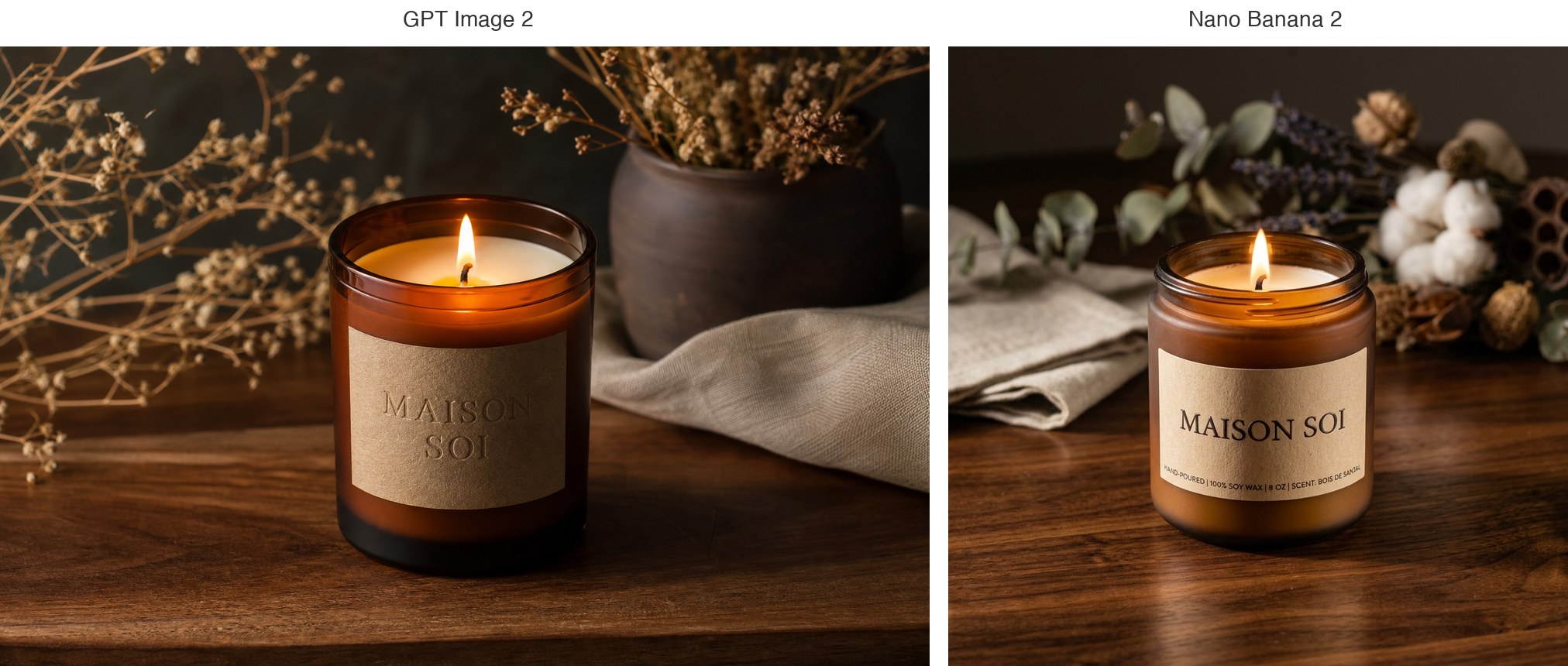
The prompt: a photorealistic still life of an artisanal soy candle in a frosted amber jar on a polished walnut surface, with a minimal kraft label reading MAISON SOI.
Both look like real product photography — believably enough to pass for a Shopify hero image. Both rendered the brand label correctly.
The difference is in the small details. Nano Banana 2 added contextually appropriate copy underneath the brand name: HAND-POURED | 100% SOY WAX | 8 OZ | SCENT: BOIS DE SANTAL. "Bois de Santal" is the actual French term for sandalwood — exactly the kind of artisanal-product detail a real candle brand would use. The model wasn't asked to add this. It just did, because it knew it belonged there.
GPT Image 2 kept the label minimal and put the candle in a warmer, more cinematic light setup — dried botanicals, golden side lighting, more editorial mood. The label has only the brand name.
If you're producing a real e-commerce listing, Nano Banana 2's catalog-style render with appropriate spec text is closer to what you'd actually use. If you're producing a brand mood board or editorial feature, GPT Image 2's warmer treatment is better.
Verdict: Nano Banana 2 wins for commercial photography. The unsolicited but appropriate label detail is the kind of thing that makes the output ship-ready instead of needing a second pass.
Test 4: Complex Multi-Element Composition
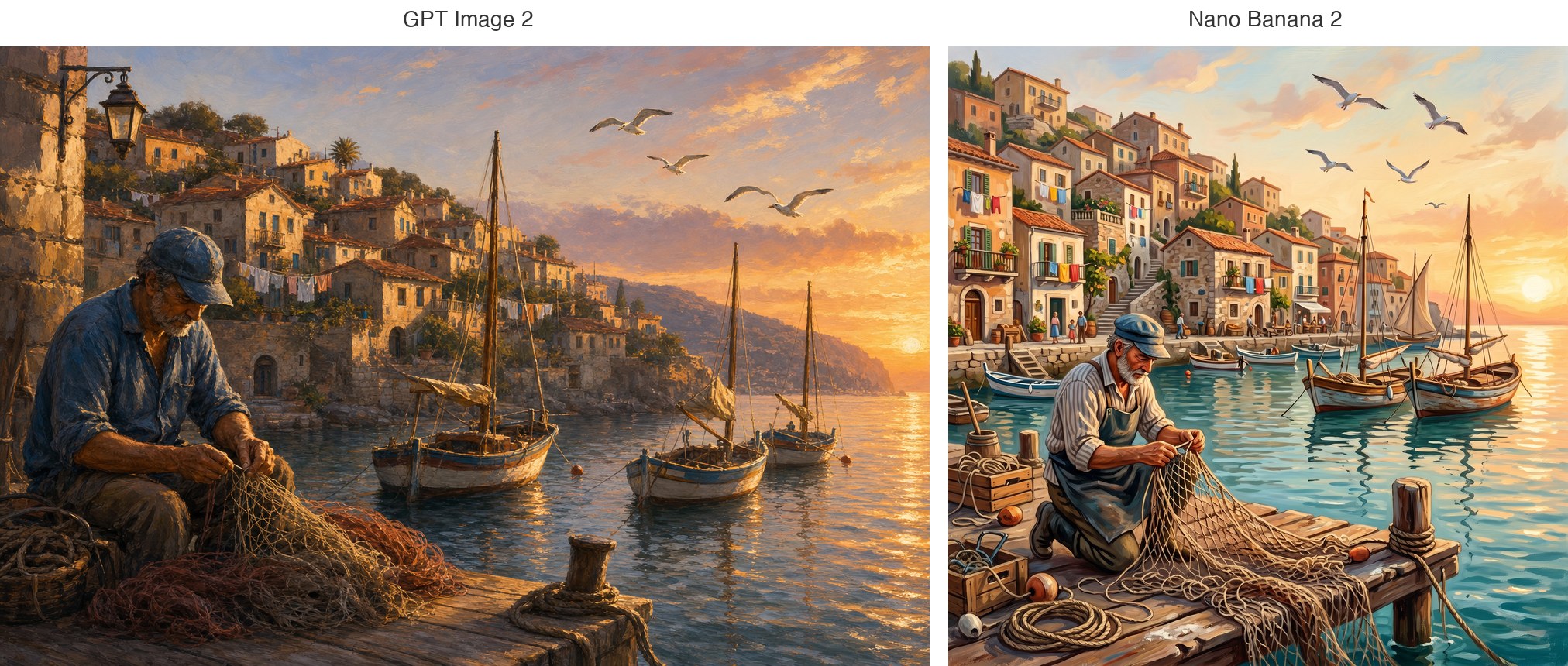
The prompt: a Mediterranean coastal village at golden hour, with a fisherman repairing nets in the foreground left, three sailboats at anchor in the middle distance, four seagulls in a loose arc above, terraced stone houses climbing the hillside.
Both models delivered all the requested elements. The fisherman, the boats, the gulls, the terraced houses, the warm light — every element is present and roughly where it should be.
GPT Image 2's version is cleaner and more illustrative. The composition is balanced and reads quickly. Nano Banana 2's version has more atmospheric depth — the setting sun is visible through soft clouds, the water has more textural variation, the houses have more architectural detail.
Neither model lost track of the element count or placement, which is the failure mode most image models hit on complex prompts.
Verdict: A tie, with a slight lean toward Nano Banana 2 if you want more atmospheric immersion, and toward GPT Image 2 if you want a more controlled illustrative composition.
Test 5: Editorial Portrait
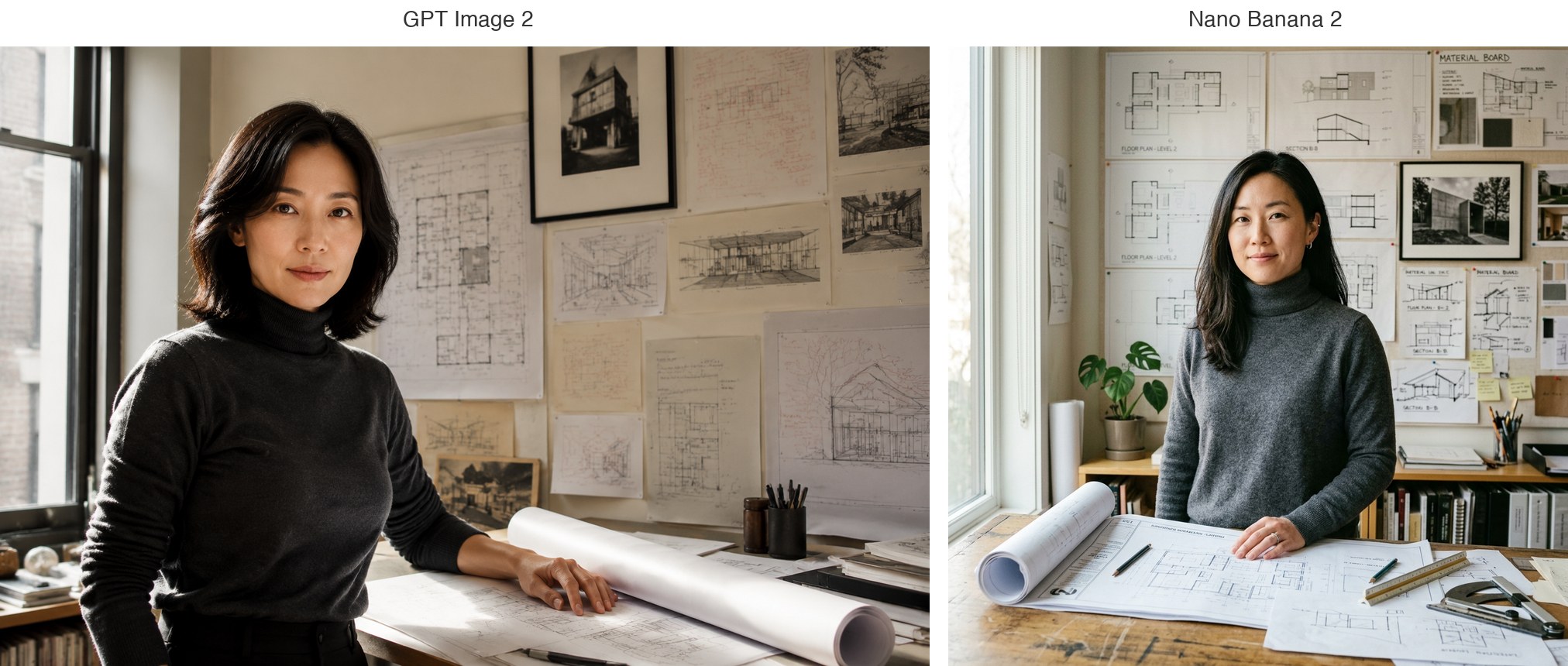
The prompt: a half-body portrait of a 35-year-old female architect in her studio, with floor plans and sketches behind her.
Both produce a believable working professional. The faces are recognizably human, the studios are filled with plausible architectural references, the lighting reads as real-window daylight.
Nano Banana 2's portrait reads as more candid — the expression is slightly more relaxed, the studio has more clutter (a plant, calipers, blueprints unrolled on a real desk), and the model added a labeled MATERIAL BOARD pinned to the wall. The added text is small but rendered correctly. The overall effect is more "real photograph someone took" than "AI-generated portrait."
GPT Image 2's portrait is more dramatic and editorial — stronger directional lighting, classical pose, focus on the face. The face itself is slightly more symmetrical than a real photograph would typically be, which gives it a subtle AI feel.
For a brand portrait or magazine feature, GPT Image 2's drama is appropriate. For "here's a photo of one of our customers" content, Nano Banana 2's candid quality reads more authentically.
Verdict: Slight edge to Nano Banana 2 for natural-portrait realism. GPT Image 2 still wins if you want classical editorial lighting.
Test 6: Text-Dense UI Mockup
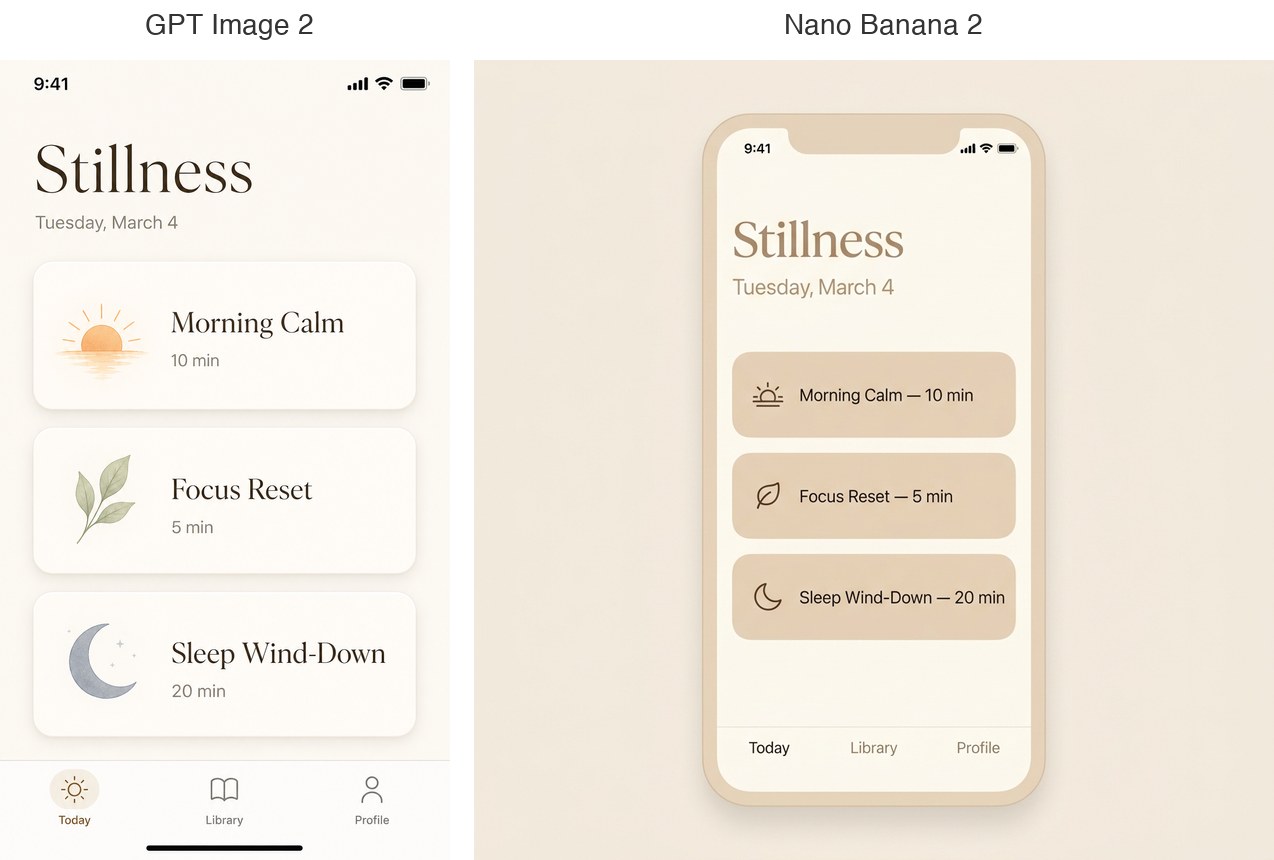
The prompt: an iPhone-style meditation app home screen, with seven discrete text strings to render correctly — the status time 9:41, app title Stillness, the date Tuesday, March 4, three session cards (Morning Calm — 10 min, Focus Reset — 5 min, Sleep Wind-Down — 20 min), and a bottom tab bar (Today, Library, Profile).
Both rendered every single text string correctly. Every word. Including the em dashes, including the minute counts, including the tab labels. This is the test where image models typically fall apart — and both passed it without errors.
The framing differs. GPT Image 2 produced a full-bleed screen — looks like a clean Figma export or actual iOS screenshot. Useful as a design reference asset. Nano Banana 2 produced a phone-in-context shot — the iPhone device frame with notch is visible, the UI is rendered inside. Useful as a marketing hero image.
Both are correct for different jobs. If you want to drop a screen into a design document, GPT Image 2's mockup is ready. If you want a product hero on a landing page, Nano Banana 2's framed device shot is ready.
Verdict: Both nailed the text. Pick by use case — UI reference (GPT Image 2) vs marketing hero (Nano Banana 2).
Speed and Cost
Across the six tests, average generation times were comparable: roughly 90 to 110 seconds per image for both models. Nano Banana 2 was slightly faster on the simpler scenes, GPT Image 2 was slightly faster on the more complex ones. Both occasionally hit timeouts on the longer generations.
At regular rates, the cost difference is modest at 1K and larger at 2K. On hiapi:
- GPT Image 2: $0.03 per image at 1K, $0.04 at 2K, $0.06 at 4K — see the pricing breakdown for details
- Nano Banana 2: $0.036 per image at 1K, $0.057 at 2K, $0.086 at 4K
At 1K regular rates, a workflow that produces 500 images a month costs $15 vs $18. For 5,000 images, $150 vs $180. Nano Banana 2 costs $0.006 more per image at 1K and $0.017 more at 2K; weigh that difference against output quality on your specific job.
The Aspect-Ratio Caveat
The most surprising finding from this test wasn't about quality — it was that Nano Banana 2 effectively ignores precise aspect-ratio requests. Across the six tests, four of which had explicit non-square aspect-ratio asks in the prompt, Nano Banana 2 returned a square or near-square image five times out of six. GPT Image 2 honored the requested ratio every time.
If you're building a workflow where output dimensions matter — magazine posters, banner ads, social media formats with strict ratios — this is a workflow blocker for Nano Banana 2. You'd have to crop or re-render after the fact.
If you're producing square outputs (Instagram tiles, profile images, product hero shots), both work.
So Which Should You Use?
Six tests is a small sample, but the pattern is consistent enough to give some real advice:
Use GPT Image 2 when:
- You need predictable aspect ratios — 3:2, 2:3, 9:16, 16:9 all work
- The job is text-heavy — posters, signage, infographics, UI mockups
- You're producing at volume and per-image cost matters
- You're doing editorial work where "designed-feeling" composition wins
Use Nano Banana 2 when:
- You need premium photorealism — product photography, portraits, food, interiors
- Square or near-square output is fine
- You want the model to add appropriate contextual detail without being asked
- Per-image cost isn't the binding constraint
For most general-purpose image generation, GPT Image 2 is the workhorse. Same level of text accuracy, more reliable formatting, 17% lower regular pricing at 1K. Nano Banana 2 is the right choice when the per-image quality on a specific style (product photography, portraits) is worth the premium — but it shouldn't be the default.
The good news is you don't have to pick one. Both models are available on hiapi through the same API — you can route by job type. For pricing details on either, see the GPT Image 2 pricing breakdown. For a longer-form hands-on take on GPT Image 2's strengths and limits beyond this head-to-head, see our GPT Image 2 honest review. To try them yourself, the GPT Image 2 model page has a Playground where you can run your own prompts before committing to either.
FAQ
Is the text rendering in GPT Image 2 really better than Nano Banana 2?
Based on this test, no — they're comparable. Both rendered English headlines, CJK calligraphy, product label text, and UI strings with the same accuracy. The marquee text-rendering advantage GPT Image 2 had when it launched has effectively been matched. If anything, Nano Banana 2 demonstrated a small extra capability: it added contextually appropriate text (product spec lines, label hints) without being asked.
Why does Nano Banana 2 ignore aspect ratio requests?
Unclear — it's a model behavior that affected most of our tests. If precise aspect ratios are required, GPT Image 2 is the safer choice. If you're producing square content, Nano Banana 2's behavior doesn't matter.
Is Nano Banana 2 worth 20% more at 1K?
For commercial product photography and natural-looking portraits, the quality difference is real and may be worth the premium. For text-heavy or formatted editorial work, GPT Image 2 delivers comparable output at $0.03 versus $0.036 per 1K image. For volume workflows, GPT Image 2 is the default; Nano Banana 2 is the specialist.
Can I use both in the same workflow?
Yes. Both models are available on the same hiapi API. You can route requests to whichever model fits the job — for example, GPT Image 2 for posters and UI screens, Nano Banana 2 for product hero shots and portraits.
What about generation time?
Average around 90–110 seconds per image for both, with Nano Banana 2 slightly faster on simpler scenes and GPT Image 2 slightly faster on complex ones. Both occasionally hit network timeouts on the longest generations.
Bottom Line
GPT Image 2 vs Nano Banana 2 isn't a simple winner-takes-all comparison. GPT Image 2 is the better default — same text accuracy, reliable formats, 17% lower regular pricing at 1K. Nano Banana 2 is the better specialist for commercial photorealism and portraits, where its quality edge can justify the higher per-image cost.
The text-rendering claim that defined GPT Image 2 at launch has largely been matched by Nano Banana 2. The remaining differentiators are aspect-ratio reliability (GPT Image 2 wins), commercial-photography polish (Nano Banana 2 wins), and price (GPT Image 2 costs $0.006 less per 1K image at regular rates).
Start with GPT Image 2 on the Playground for any new project. Switch a specific subset of jobs to Nano Banana 2 only when the quality difference on your specific style is visible and worth the premium.