
List
Best Hugging Face Inference API Alternatives (2026): One API for Images, Video, Audio, and LLMs
Pricing models, model coverage breadth, integration complexity, and OpenAI compatibility — understand clearly when to switch from an aggregated router to a unified generation API
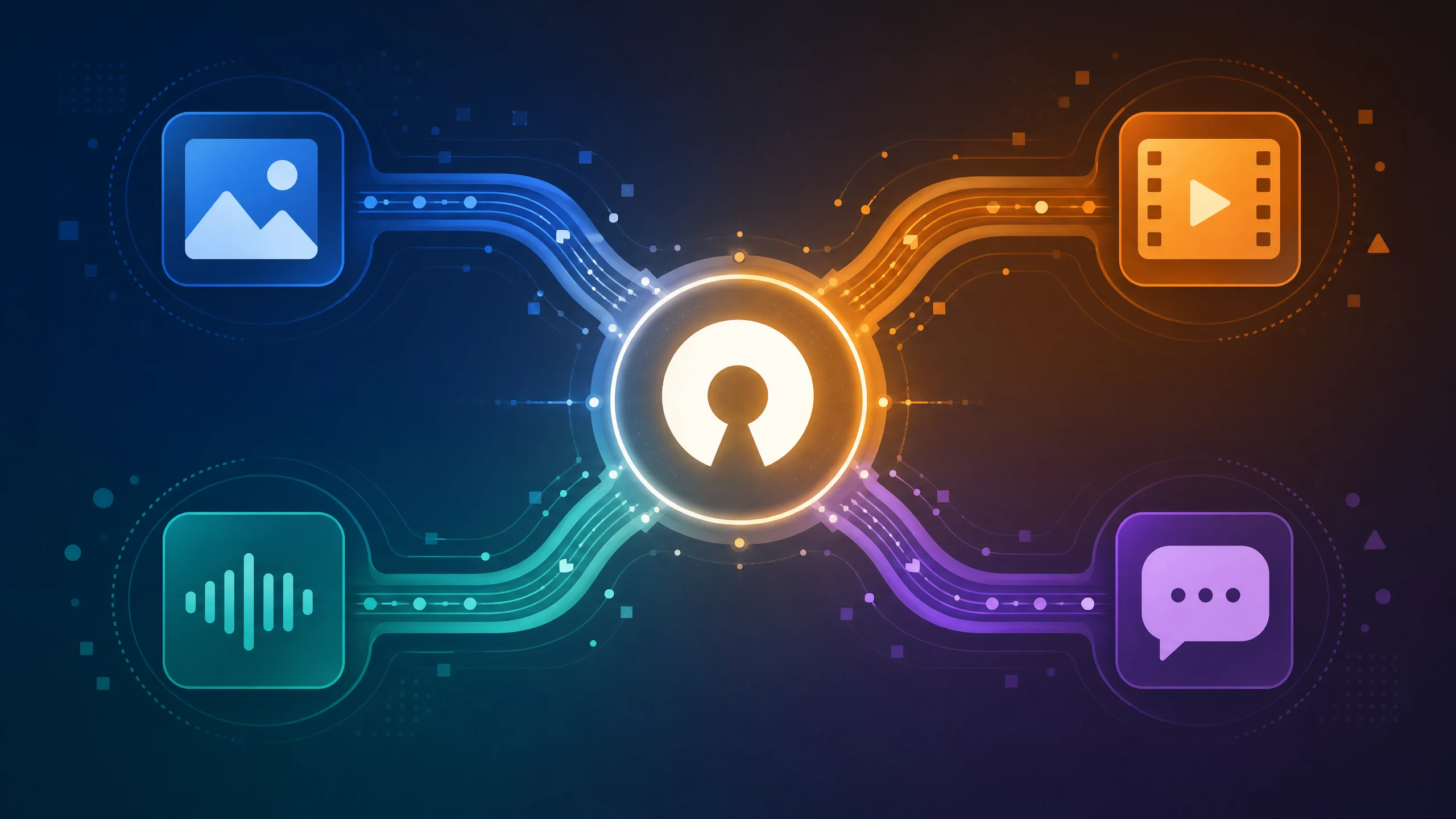
Hugging Face is arguably the oldest and deepest node in the open-source AI ecosystem. The Transformers library, the hundreds of thousands of open-source models on the Model Hub, and runnable demos hosted on Spaces together form a complete toolchain for model users and builders — and to this day no second player has fully replicated it. Inference Providers (formerly the Serverless Inference API) is the piece of this ecosystem aimed at inference calls: it aggregates multiple third-party inference providers behind a routing layer, and developers call it with a unified Hugging Face API Key. Billing runs through the PRO/Team/Enterprise quota in your HF account, or you bring your own third-party key and HF forwards the request.
But if you don't need to pick specific model weights, don't plan to touch Transformers or train/fine-tune models yourself, and just want one key and one request format to get back image, video, audio, or text results, the aggregation layer of Inference Providers introduces some extra complexity: it doesn't directly provide image/video/audio generation compute itself, but forwards to the third-party providers behind it, and each provider's model list, rate limits, and billing details aren't fully unified. Moreover, its OpenAI-compatible layer currently only covers Chat Completions (text); image and speech modalities either go through each provider's own SDK or through Hugging Face's dedicated client libraries — not a single unified request format.
This article looks at a few options that better fit the need for a "unified pay-per-call API."
Best Alternatives
HiAPI: One Key for Images, Video, Audio, and Text with a Unified Request Format
HiAPI's positioning is similar to Inference Providers' aggregation approach — both put multiple generation capabilities behind a single entry point. The difference is that HiAPI maintains its own unified asynchronous task interface (POST /v1/tasks), where image, video, and audio generation all use the same request and polling format, so you don't need to adapt parameters separately for each provider. Text traffic goes through an OpenAI-compatible Chat Completions interface — just change the base URL and your existing integration code barely needs changes. The current model library totals 60+, covering all four modalities: for images, GPT Image 2, Nano Banana 2/Pro, Seedream 5, FLUX 2, and Qwen Image; for video, Veo 3.1, Kling 3, Seedance 2.5, Hailuo, Wan, MiniMax, and more; for audio, Suno, ElevenLabs, MiniMax Music, and Qwen Audio. Billing is per successful call, with no minimum spend, failed generations are not charged, and new accounts get 200 credits on sign-up. For individual model pricing, refer to the live numbers on the pricing page.
HiAPI also offers a native remote MCP service (mcp.hiapi.ai/mcp, no local deployment needed) and Agent Skills for Claude Code and Codex, so coding agents can trigger generation directly without writing their own polling scripts.
Who it's for: teams that don't need to pick specific open-source model weights, don't plan to train or deploy models themselves, and just want one key and one request format covering all generation modalities.
Replicate: The Broadest Open-Source Model Library, Directly Callable
Replicate (acquired by Cloudflare in December 2025) is itself a common hosting outlet for many open-source models on the Hugging Face Model Hub, covering everything from mainstream image and video generation models to niche research checkpoints, and community-uploaded custom models can be called directly as well. Pricing is a hybrid model: official models are priced by output, while deployments packaged as custom Cogs are priced by compute seconds. Replicate runs an officially hosted MCP server (mcp.replicate.com) that supports direct generation calls, not just managing deployments.
Who it's for: developers who want to call directly across the broadest range of open-source and community models without managing Inference Endpoints themselves.
fal.ai: The Fastest Inference Speed
fal.ai's reputation is built on inference speed; after new open-source image and video models are released, fal.ai is usually one of the first platforms to offer low-latency optimized endpoints, covering 600+ models. Billing is pay-per-call by output, and prepaid credits are valid for 365 days. One thing to note: fal's official MCP server is currently documentation-style only — it helps agents look up how to call fal's API, but cannot generate media directly through MCP.
Who it's for: latency-sensitive scenarios where you're willing to pay a premium for the fastest generation speed.
Together AI: Itself One of the Providers Behind Hugging Face Inference Providers
Together AI is itself one of the third-party providers in the Hugging Face Inference Providers aggregation list. In other words, calling a Together-hosted model through HF adds an extra routing layer on top of Together's API; if you already know the model you want is provided by Together, going directly to Together is more direct. Together is usually categorized as an LLM inference platform, but it also has image (FLUX series, Stable Diffusion), video (Imagen, Veo 3.0), and audio (Cartesia, Whisper) capabilities, plus its own catalog of open-weight LLMs. Together has also released an official MCP server, oriented toward coding agents and fine-tuning workflows rather than general media generation.
Who it's for: teams that have confirmed the model they want is hosted by Together and want to skip HF's aggregation layer, or teams that want LLM inference and media generation billed under the same account.
Quick Comparison
| Platform | Best For | Billing | OpenAI Compatible (Text) | Image/Video/Audio Generation |
|---|---|---|---|---|
| HiAPI | One key covering images, video, audio, and text with a unified request format | Per-call, pay-as-you-go, failures not charged | Yes, Chat Completions | Native support, 60+ models across four modalities with a unified async task interface |
| Hugging Face Inference Providers | Already using open-source model weights and the Transformers/Spaces ecosystem, want to call generation models along the way | Uses HF PRO/Team/Enterprise quota, or bring your own third-party key | Yes, but only Chat Completions (text) | Forwarded to third-party providers, billed and limited per provider; HF's native hf-inference layer is currently more CPU/text-oriented |
| Replicate | Browsing and directly calling the broadest range of open-source/community models | Official models priced by output; custom deployments priced by compute seconds | Partially supported, depending on model | Broad, deep image/video coverage, less audio |
| fal.ai | Latency-sensitive, need the fastest inference speed | Priced by output, prepaid credits (valid 365 days) | Partially supported, depending on model | Broad, mainly image/video |
| Together AI | Known model is hosted by Together, or want to consolidate LLM and generation billing | Per-call / per-token | Yes, Chat Completions | Image (FLUX series, SD), video (Imagen, Veo 3.0), audio (Cartesia, Whisper) |
How to Choose
- Need specific open-source model weights, want to fine-tune or train with Transformers, or rely on Spaces-hosted demos → stay in the Hugging Face ecosystem; Inference Providers suits your occasional inference calls
- Want one key covering images, video, audio, and LLM calls, priced per call, without integrating multiple provider accounts → HiAPI
- Want to browse and directly call the broadest possible range of open-source and community models → Replicate
- Latency is the deciding factor and you need the fastest inference speed → fal.ai
- Already confirmed the model you want is hosted by Together, or already pay Together for LLM traffic → Together AI
FAQ
Is HiAPI a good alternative to Hugging Face Inference API?
It depends on what you were using Hugging Face for. If you rely on specific open-source model weights, Transformers fine-tuning, or Spaces hosting, HiAPI can't replace that part — it's a model ecosystem question, not an API-calling question. If you use Inference Providers only to have a single entry point for calling image, video, audio, or LLM generation and don't care which provider is running behind it, HiAPI offers the same idea but with a more unified request format, so you don't need to adapt to each third-party provider's parameter differences.
What is the core difference between Hugging Face Inference Providers and HiAPI?
Inference Providers is an aggregated routing layer that forwards requests to the third-party inference providers attached behind it, and each provider's model list, quotas, and billing details aren't fully unified; OpenAI compatibility currently covers only text Chat Completions, while image and speech go through each provider's own format. HiAPI maintains its own unified asynchronous task interface directly, using the same request and polling format for images, video, and audio, and the same OpenAI-compatible endpoint for text — no per-provider adaptation needed.
Which is cheaper?
The two have different billing logic, so a direct comparison depends on your specific usage pattern. On the Hugging Face side, Free accounts have access limits, PRO subscription quota is shared with other HF compute services rather than exclusive to Inference Providers, and Team/Enterprise starts per seat; HF itself doesn't add a markup, but the actual rates of the providers behind it vary, so refer to Hugging Face's official pricing page for specifics. HiAPI charges a fixed per-call price for each model — see the pricing page for specific rates — with failures not charged and no minimum spend. Low-frequency, fluctuating usage is usually better suited to per-call pricing.
How do I migrate from Hugging Face Inference Providers to HiAPI?
Sign up for an account and get an API Key; for text traffic, point your OpenAI-compatible client's base URL to HiAPI; for images, video, or audio, submit tasks to POST /v1/tasks with the model name and prompt, then poll (or use a callback) to get the result link. You no longer need to distinguish which third-party provider is behind the request.
Do all these platforms support OpenAI-compatible interfaces?
For text traffic, HiAPI, Hugging Face Inference Providers, and Together AI all provide OpenAI-compatible Chat Completions interfaces. Replicate and fal.ai's OpenAI-compatible support depends on the specific model and isn't full coverage. For images, video, and speech, no platform has achieved a fully unified OpenAI-compatible format yet, including Hugging Face itself.
Conclusion
Hugging Face's accumulated strengths in the open-source model ecosystem, Transformers and Spaces integration, and model customizability can't be replaced in the short term by any pay-per-call API — that's not the battle Inference Providers should be fighting. But if all you need is a unified entry point to call image, video, audio, and LLM generation per call, without caring which provider is behind it, HiAPI, Replicate, fal.ai, and Together AI are all reasonable starting points: HiAPI wins on one unified request format covering all modalities, Replicate wins on the breadth of its open-source model library, fal.ai wins on speed, and Together AI wins if you already know the model you want is hosted by it.
Sign up for HiAPI for free and try any of the models mentioned above. New accounts get 200 credits, and failed generations are not charged.
Related Reading
Related articles
View all articles →-

List
Best RunPod Alternatives in 2026: Choosing an Image and Video API
RunPod is a GPU cloud, not a generation API — here's how to pick the right layer for image and video work.
-
List
Best Modal Alternatives in 2026: Choosing an Image and Video API
Modal is built for deploying your own models. If you need a pre-built image or video generation API instead, here are four platforms worth comparing.
7 -

List
Best Runway ML Alternative (2026): Unified API for Gen-4 Style Video & Image Workflows
Where Runway ML's Gen-4 ecosystem wins, and when a unified, pay-as-you-go API fits a dev workflow better.