
Kuaishou
Kling 2.5
kling-2.5-turbo/image-to-video
An image-to-video model launched by Kuaishou, standing out for its smooth motion and character consistency, with support for negative prompts and CFG adjustment, making it suitable for generating short clips with highly dynamic camera work
Try kling-2.5-turbo/image-to-video
Input
Showcases
View all showcasesOutput
videoStoryboard proof of concept: push-in transition between first and last frames
Style Storyboard · Image-to-Video · Cinematic
Reference inputs

image_urls
Prompt
Cinematic image-to-video shot: the camera slowly and steadily pushes in from a wide-angle composition to a medium close-up, foreground elements produce subtle parallax, and the background gradually transitions to a shallow depth of field. Soft directional key light from the upper left, fabric and hair sway naturally and slightly, and ambient dust floats in the light beams. Maintain color grading consistent with the character's identity and the first frame. Motion is smooth and physically plausible, with no cuts and no flicker.
Copy the full prompt and adapt it for your own generation.
Tags
Image-to-Video Prompt Formula Card: A Visual Demonstration of the Structured Approach
Style Prompt Engineering · Image-to-Video · Motion Design
Reference inputs

image_urls
Prompt
Animate a single static reference frame into a short cinematic video: a designer's desk in a dimly lit studio, a freestanding translucent glass panel, and a soft beam of light sweeping across the panel from left to right. Slow lateral camera movement, subtle parallax, dust floating in the light. Fine, physically plausible motion, smooth transitions, shallow depth of field, 1080p cinematic quality, desaturated teal and amber tones, no text, no watermark.
Copy the full prompt and adapt it for your own generation.
Tags
Kling 2.5 Image-to-Video Cinematic Language Notes: Camera Movement Demonstration
Style Camera Movement · Storyboard · Image-to-Video
Reference inputs

image_urls
Prompt
An image-to-video camera study based on a single still frame. The camera performs one controlled, slow push-in on the subject while the environment responds with subtle motion—dust motes floating in the light, faint parallax in the background layer—keeping the subject's pose and identity consistent. Cinematic 16:9 composition, natural and plausible lighting, shallow depth of field, smooth steady camera movement with no cuts, a single 5-second shot.
Copy the full prompt and adapt it for your own generation.
Tags
Kling 2.5 Turbo Image-to-Video Capability Illustrated: Shot Control from First Frame to Last Frame
Style Image-to-Video · Camera Control · Cinematic
Reference inputs

image_urls
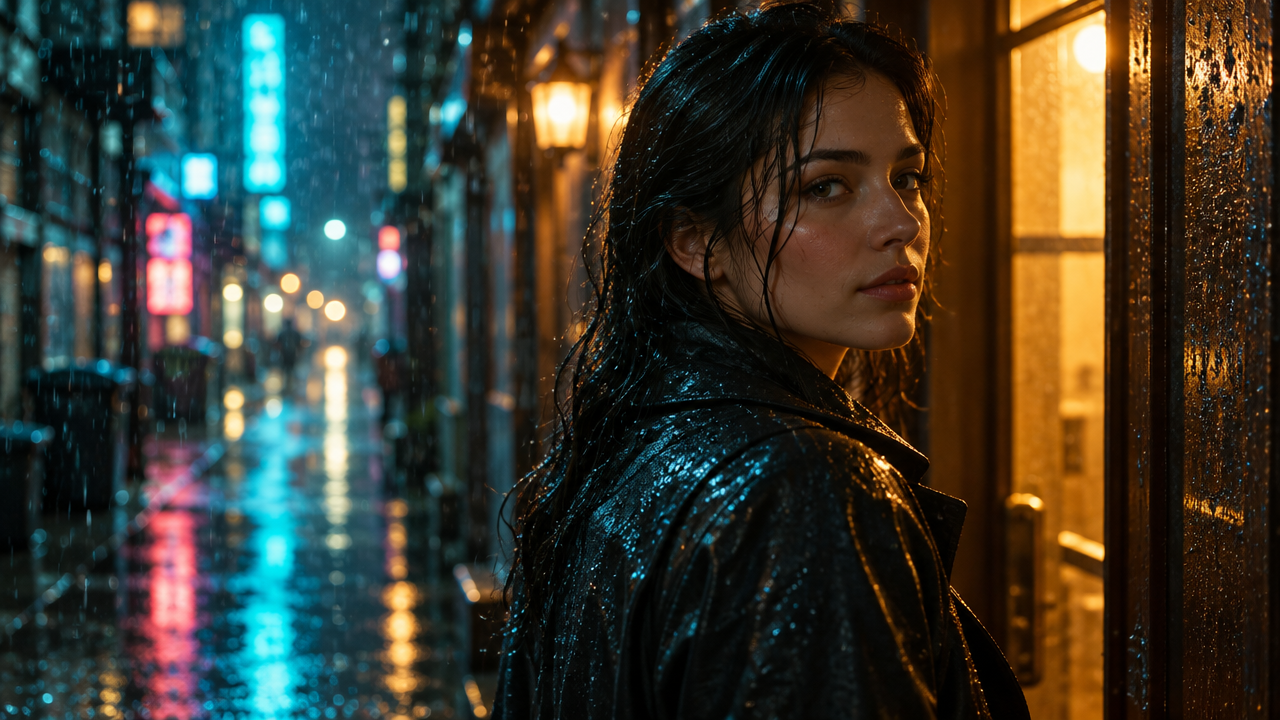
image_urls
Prompt
Image-to-video transition shot. Starting with a 16:9 widescreen frame, the scene is a rain-soaked neon alley at night, with a lone figure in a dark coat standing quietly at the far end of the alley; the camera slowly pushes forward along the wet pavement, and the reflections of signs are stretched long beneath the lens. The figure turns and walks toward the camera with steady, weighty steps, the hem of the coat and the hair swaying with the wind and rain; raindrops hit the ground, splashing visible droplets and ripples. At the medium shot, the camera arcs to the right, keeping the subject centered in frame as background signs sweep past with parallax. It ends on a closer three-quarter composition; as the figure passes the doorway light, they glance back over the shoulder, their expression shifting from tense to calm. Smooth continuous motion, realistic physics, cinematic teal and amber lighting, shallow depth of field, fine film grain, no camera shake artifacts, no distortion in the face or hands.
Copy the full prompt and adapt it for your own generation.
Tags
Pricing
kling-2.5-turbo/image-to-video per second
| Unit Price | $0.060 |
|---|
Positioning Overview
kling-2.5-turbo/image-to-video is a model for image-to-video tasks: it takes one or two images as the first frame and an optional last frame, combines them with a text prompt, and generates a short 5-second or 10-second video. It supports negative prompts and a prompt-adherence strength adjustment from 0 to 1, and the aspect ratio can be selected based on single-image or dual-image mode. It is suited to developers who need to turn static images into dynamic clips and want to control the visual content through parameters.
Core Highlights
- Driven by first and last frame images — you can pass one first-frame image or also add a last-frame image, so the video starts from a specified image and transitions to a specified ending image.
- Adjustable prompt adherence strength — cfg_scale adjusts between 0 and 1 how closely the video follows the text description, making it easy to trade off between creative freedom and strict reproduction.
- Negative prompts exclude interference — supports negative prompts of up to 2496 characters, used to suppress content you do not want to appear in the frame.
Capability Details
First-frame and optional last-frame input: image_urls accepts 1 to 2 image URLs, supports jpeg/png/webp, with a maximum of 10MB per image; when two images are passed, the video is generated as a transition from the first frame to the last frame.
Duration and aspect ratio selection: duration can be 5 or 10 seconds; in single-image mode the aspect ratio supports 16:9, 9:16, 1:1, 4:3, 3:4, and 21:9, while dual-image mode is limited to 16:9, 9:16, and 1:1.
Prompt and negative prompt: prompt is required and up to 2500 characters, used to describe subject motion, environmental changes, and camera movement; negative_prompt is up to 2496 characters, used to exclude unwanted content.
Adherence adjustment: cfg_scale ranges from 0 to 1; the higher the value, the more closely the video follows the text description, so you can adjust how well the generated result matches the shot requirements.
Use Cases
- Ad and product short-video creators: a single product image + motion description — turn a static product image into a short clip with camera movement, for dynamic display assets in brand or e-commerce videos.
- Film and TV previsualization: concept images + specified first and last frames — use two concept images to lock the start and end frames, and generate a transition clip as a storyboard or concept preview.
- Social media content operations: a vertical image + a short prompt — convert an image into a 5-second or 10-second vertical short video at 9:16, ready for direct publishing on social platforms.
Limitations and Selection Advice
A single generation is capped at 10 seconds, so it is not suitable for directly producing long videos; dual-image mode only supports 16:9, 9:16, and 1:1, while single-image mode may follow the original image's ratio during fallback processing and cannot guarantee an exact match to the requested size. WebP images are not converted automatically, and some fallback processing accepts only jpeg/png. Generation quality depends heavily on prompt writing and cfg_scale tuning. If you need to generate video directly from text, choose a text-to-video model from the same family.
What's new
View changelog →- New model Added kling-2.5-turbo/text-to-video docs
- New model New video model docs
Create a generation task
https://api.hiapi.ai/v1/tasks Headers
AuthorizationstringRequiredAccount API key. Required on every request. Example: Bearer YOUR_HIAPI_API_KEY. Get your API key
Content-TypestringOptionalThe request body is always parsed as JSON; when sent, only application/json (optionally with charset) is accepted — any other value returns 415. Example: application/json.
Idempotency-KeystringOptionalIdempotency key, up to 255 bytes. Retries with the same key from the same account create the task only once; replays return the original taskId.
On network timeouts or client retries, the same key creates the task only once — no double charges (scope: the API key's account). Use a business-unique identifier as the key (e.g. "order-42"); replays return the original taskId, and keys expire 24 hours after the first request. See the Unified Async API overview for the full scenario matrix.
Body
modelstringRequiredCurrent fixed value: kling-2.5-turbo/image-to-video
routestringOptionalCurrent fixed value: default
inputobjectRequired
Business parameters for kling-2.5-turbo/image-to-video and route default — see the parameter table below.
promptstringRequiredminLength 1maxLength 2500Text prompt describing the subject's motion, environmental changes, and camera movement, which determines the direction of the generated video content.
durationintegerOptionalDefault: 5min 5max 10Select the number of seconds for the generated video as an integer, default 5.
510cfg_scalenumberOptionalmin 0max 1Adjust how closely the video follows the text description; takes a numeric value, and the higher the value, the more closely it adheres to the prompt.
image_urlsarrayRequiredminItems 1maxItems 2Array of image URLs for the first frame and an optional last frame, supporting jpeg/png/webp, max 10MB each; some fallback processing accepts only jpeg/png, WebP is not automatically converted, and with two images only 16:9, 9:16, or 1:1 is supported.
Array [ string ]
aspect_ratiostringOptionalDefault: "16:9"Video aspect ratio, default 16:9; with a single image, fallback processing may follow the original image's ratio, and an exact match to the requested dimensions is not guaranteed; when image_urls is provided, only 16:9, 9:16, or 1:1 is supported.
16:99:161:14:33:421:9negative_promptstringOptionalmaxLength 2496Content you do not want to appear in the video, as a string, up to 2496 characters.
callbackobjectOptional
Terminal-state notification config. When omitted, no callback is delivered — poll the task yourself. See the callback note below.
Provide callback.url when creating a task and HiAPI POSTs to your service once the task reaches a terminal state — no polling needed. The callback payload mirrors the task detail structure; signature verification, delivery retries and idempotency are documented on the Unified Async API overview page.
urlstringRequiredRequired when callback is present. A POST is sent to this URL once the task reaches a terminal state; must be a valid http(s) URL.
whenstringOptionalDefault: "final"Only final is supported today — notified on both success and fail.
finalstoragestringOptionalDefault: "temp"Artifact storage tier: temp (default, retained about 7 days) or persistent (long-term, billed by size). Insufficient balance or exceeding the storage cap silently downgrades to temp; the effective tier is shown in the task detail response.
temppersistentRequest examples
# Submit an async task; returns a taskId immediately (no waiting for generation)
curl -X POST "https://api.hiapi.ai/v1/tasks" \
  -H "Authorization: Bearer $HIAPI_API_KEY" \
  -H "Content-Type: application/json" \
  -d '{
  "model": "kling-2.5-turbo/image-to-video",
  "input": {
    "prompt": "…",
    "duration": 5,
    "image_urls": "…",
    "aspect_ratio": "16:9"
  }
}'
const res = await fetch("https://api.hiapi.ai/v1/tasks", {
method: "POST",
headers: {
Authorization: `Bearer ${process.env.HIAPI_API_KEY}`,
"Content-Type": "application/json",
},
body: JSON.stringify({
model: "kling-2.5-turbo/image-to-video",
input: {
"prompt": "…",
"duration": 5,
"image_urls": "…",
"aspect_ratio": "16:9"
}
}),
});
const task = await res.json();
// { code: 200, message: "success", data: { taskId } }import os, requests
res = requests.post(
"https://api.hiapi.ai/v1/tasks",
headers={"Authorization": f"Bearer {os.environ['HIAPI_API_KEY']}"},
json={
"model": "kling-2.5-turbo/image-to-video",
"input": {
"prompt": "…",
"duration": 5,
"image_urls": "…",
"aspect_ratio": "16:9"
}
},
)
print(res.json()) # { code, message, data: { taskId } }200 OK
{
  "code": 200,
  "message": "success",
  "data": {
    "taskId": "tk-hiapi-01HZTQ8BX2N3GM3YFK4Z9D7VQR"
  }
}
400 Bad Request
{
  "code": 400,
  "message": "invalid request",
  "data": null,
  "error_code": "INVALID_REQUEST"
}
Get task detail
https://api.hiapi.ai/v1/tasks/:id Response fields
taskIdstringRequiredTask ID, always prefixed with tk-hiapi-.
modelstringRequiredResolved full model name. Tasks submitted with the route parameter return base@route (e.g. gpt-image-2/text-to-image@ext); otherwise identical to the name passed at creation.
routestringOptionalPresent only when the task was submitted with an explicit route parameter; echoes the submitted value.
statusstringRequiredTask status.
queued Queued, not started yet.
handling Being processed.
archiving Processing finished, artifacts being prepared.
success Terminal: completed, artifacts available (output returned).
fail Terminal: failed (error returned).
After submission, check status: success and fail are terminal, everything else is non-terminal. Poll every 1–3 seconds until terminal. On success, download artifacts from output[].url and transfer them before expireAt; pass storage: "persistent" at creation time when long-term retention is needed.
creatednumberRequiredTask creation time (Unix seconds).
completednumberRequiredUnix seconds when the task reached a terminal state; fixed to 0 while not terminal.
outputarrayOptional
Present only when status == success. Artifact list — always an array; a single task may return multiple types at once (e.g. video + first_frame).
Array [ object ]
Array items
urlstringRequiredArtifact URL, directly downloadable.
typestringRequiredCurrent possible values: video, image, audio, first_frame, last_frame, thumbnail; more may be added later.
expireAtnumberRequiredUnix seconds until which the artifact remains accessible; download or transfer before it expires.
errorobjectOptional
Present only when status == fail.
codestringRequiredBusiness error code.
messagestringRequiredError description.
Response examples
Success
{
  "code": 200,
  "message": "success",
  "data": {
    "taskId": "tk-hiapi-01HZTQ8BX2N3GM3YFK4Z9D7VQR",
    "model": "happyhorse-1-0",
    "status": "success",
    "created": 1777282033,
    "completed": 1777282099,
    "output": [
      {
        "url": "https://cdn.hiapi.ai/tasks/.../video.mp4",
        "type": "video",
        "expireAt": 1777886899
      }
    ]
  }
}
Processing (non-terminal)
{
  "code": 200,
  "message": "success",
  "data": {
    "taskId": "tk-hiapi-...",
    "model": "happyhorse-1-0",
    "status": "archiving",
    "created": 1777282033,
    "completed": 0
  }
}
Failed
{
  "code": 200,
  "message": "success",
  "data": {
    "taskId": "tk-hiapi-...",
    "model": "happyhorse-1-0",
    "status": "fail",
    "created": 1777282033,
    "completed": 1777282099,
    "error": {
      "code": "TASK_FAILED",
      "message": "task failed"
    }
  }
}Articles
View all articles →Related Models
View all models →Same Type
-
 MiniMax H3 MiniMax $0.072 /second
-
 Kling AI Avatar Kuaishou --
-
 Kling 3.0 Turbo Kuaishou $0.130 /second
-
 Gemini Omni Google --
-
 FLUX 3 Max Black Forest Labs $0.061 /second
-
 Grok Imagine 1.5 Lite xAI $0.029 /second
-
 Gemini Omni 1.1 Flash Google $0.450 /video
-
 HeyGen Avatar IV HeyGen $0.150 /second
-
 FLUX 3 Video Black Forest Labs $0.090 /second
-
 Veo 3.1 Fast Google $0.170 /second
-
 Seedance 2.0 ByteDance $0.017 /second
-
 HappyHorse 1.1 Alibaba $0.160 /second