
Visual Notes on Camera Language: A Single-Image-Driven Shot Demonstration
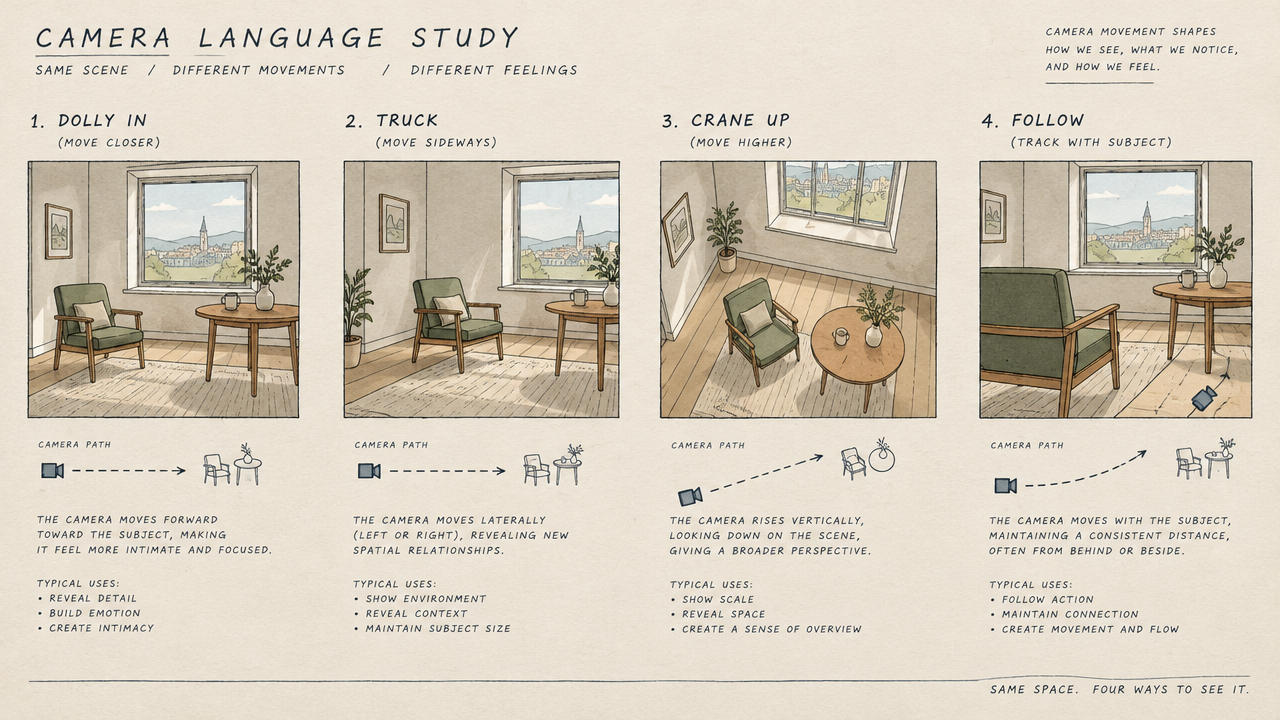
Using a single static schematic frame as a starting point, Gemini Omni Flash (image-to-video) turns the abstract concept of "camera movement" into watchable shot motion. The main subject is a hand-drawn style note on camera language: the same scene is divided into several composition zones, labeled with camera position changes such as push in, pull out, pan, tracking, and follow; the input frame determines the composition, color palette, and line-art texture, while the prompt only describes the camera behavior and sound atmosphere that unfold over time, thereby turning the "note" into a "demonstration". In terms of composition, the work has only one source material: the hand-drawn storyboard sketch. It serves two purposes at once—providing the model with a stable reference for scene and subject consistency, and giving the output a readable information hierarchy (annotation lines and composition frames). The base fixes 16:9, 8 seconds, 720p, and a seed, making it easy to reproduce and compare the effects of different camera-movement descriptions. Use cases: rapid visual alignment on camera-movement vocabulary for storyboard/video teams; illustrated camera-language animations for teaching or popular-science content; and also as an input paradigm example for image-to-video workflows—one reference image plus one camera-language description yields a dynamic draft ready for discussion.
Style Camera Movement · visual-notes · Storyboard
Model Gemini Omni
Reference inputs
image_urls
Prompt
Animate a single hand-drawn camera-language study sheet into a short dynamic demonstration. The sheet shows a stylized interior scene divided into multiple composition panels, with thin-line annotations and arrows. Camera language: slowly and steadily push in toward the center panel, then gently pan right along the row of panels, and finally end with a slight pedestal-up tilt, revealing the entire annotated layout. Maintain the paper texture and crisp ink lines; as the camera passes the arrows and composition frames, they pulse slightly. Keep the lighting flat, graphic, and diagrammatic, with a soft paper grain. No text warping, no deformation of the drawn scene, only parallax and camera motion; accompany with quiet room ambience and a subtle pen-scratch texture.
Copy the full prompt and adapt it for your own generation.
Tags