
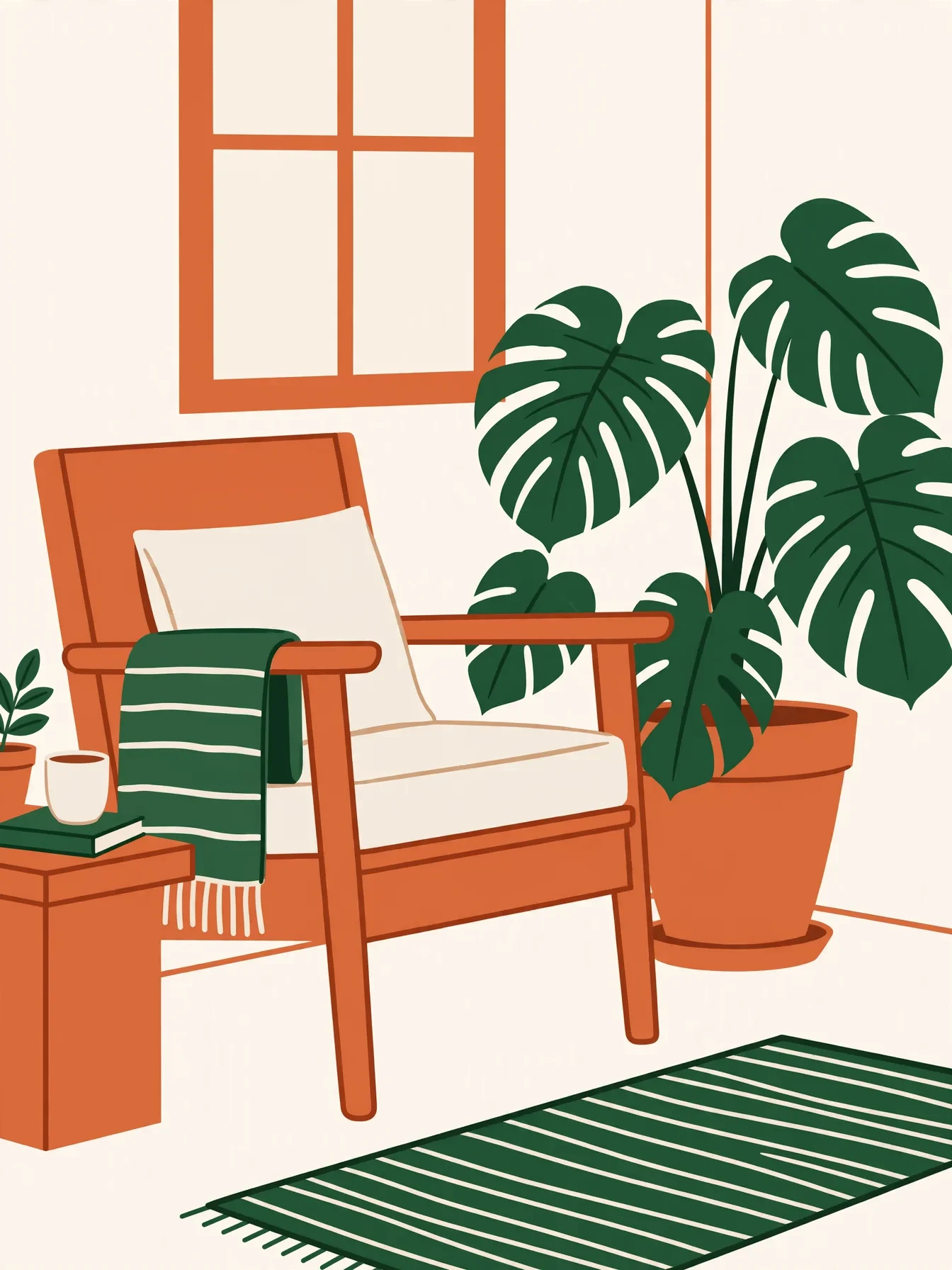
Style Spectrum: Step-by-Step Translation from Realistic Photo to Flat Illustration
A style spectrum experiment using the image-to-image capability of muse-image-1.0: take the same realistic reference image (a rattan chair and green plants on a porch, side lighting, shallow depth of field) and push it toward flatness through progressively tighter prompts—preserving the subject's identity and compositional skeleton while gradually stripping away material texture, lighting gradations, and depth of field, ultimately arriving at a flat illustration with distinct color blocks and clear outlines. The work produces one reference asset (the original realistic photo), and then the author pipeline uses that image as the sole reference to generate the target-style image; the prompt explicitly states "what to preserve and what to change," which is exactly how this pipeline supports reference images plus instruction-based rewriting. Aspect ratio and output format use the schema's non-media parameters. Suitable as a control baseline for style transfer, a direction preview before outsourcing illustration work, or for batch-producing flat versions with a unified visual vocabulary for the same set of product/scene images. Single-image reference, single-image output, simple workflow, easy to reuse in batch tasks.
Style style-transfer · Flat illustration · Reference guidance
Model Muse Image 1.0
Reference inputs

image_urls
Prompt
A flat vector illustration transformed from a reference photo: keep the subject's identity, the chair's outline, and the plant positions exactly consistent with the reference image, but flatten everything else. Replace photographic lighting with two to three solid tones, compress depth of field into overlapping flat planes, remove texture and grain, use clean crisp outlines, and a restrained palette of warm terracotta, off-white, and deep green. No gradients, no cast shadows, no photographic detail retained. Centered composition with ample negative space, editorial illustration style.
Copy the full prompt and adapt it for your own generation.
Tags