Comparison
Best Ideogram Alternatives (2026): A Unified API for Typography and Design Image Workflows
Should you switch from Ideogram to a unified API? First, look at the real gaps in text rendering, model coverage, and training capabilities.

Ideogram does a solid job with typography. Whether it's logo wordmarks, poster headlines, or illuminated signage, its spelling accuracy is a benchmark in the industry — that's worth stating up front, because it isn't something that can easily be replaced.
But if your product needs more than just getting text drawn correctly — if it also needs the same set of credentials to call video, audio, and more image models, or if you want to integrate quickly via an OpenAI-compatible format — then Ideogram, as a model family specializing in typography, will look limited in coverage. Ideogram itself has aggregated third-party models like GPT Image and Nano Banana within its own product to fill this gap, which shows the need is real.
This article lays out three viable replacement/complementary paths, objectively compares their strengths and weaknesses, and helps you decide when to use Ideogram and when to take a different route.
Best Alternatives
1. HiAPI (Unified API, recommended for teams needing multimodality + a single integration)
HiAPI is a unified inference API aggregating 60+ models, with image, video, audio, and LLM all called using the same API key. Its differentiator isn't that it does typography better than Ideogram — it's that Ideogram's own ideogram-v4 model is directly hosted in the same account. Switching to HiAPI doesn't mean giving up Ideogram's typography capabilities; it just puts it and other models into the same interface.
Unified interfaces are HiAPI's core selling point: text goes through OpenAI-compatible Chat Completions endpoints, while image/video/audio go through a unified asynchronous task interface (POST /v1/tasks plus polling or callbacks) — one SDK and authentication method covers all modalities. If your team needs to do typography images, short video assets, and background music all at once, you don't need to integrate a separate vendor for each modality.
Interface example (calling ideogram-v4):
{
  "model": "ideogram-v4",
  "input": {
    "prompt": "An art deco cinema marquee at night: the words STARLIGHT DRIVE-IN in glowing gold channel letters, all lettering accurate and crisp",
    "aspect_ratio": "16:9",
    "rendering_speed": "QUALITY"
  }
}
Image: Actual output from ideogram-v4 at the QUALITY setting, showing its text rendering precision.
To be honest, HiAPI, as a hosted inference API, does not provide a custom model training interface like Ideogram does. If your need is to train a dedicated font style or brand model based on your own materials, that capability currently has to be done via Ideogram's own training interface — HiAPI is positioned to call already-trained models, not to be a training or deployment platform.
2. Ideogram V4 (hosted and called via HiAPI)
If you're set on Ideogram's typography results and just want a different integration method, ideogram-v4 itself can be called directly on HiAPI. The parameter structure is straightforward: prompt is required, rendering_speed has three tiers (TURBO/BALANCED/QUALITY, with QUALITY priced at about 3x TURBO), and aspect_ratio offers five formats. It's suitable for scenarios like logo wordmarks, poster typography, and neon signage, and its spelling accuracy for English text remains its signature strength.
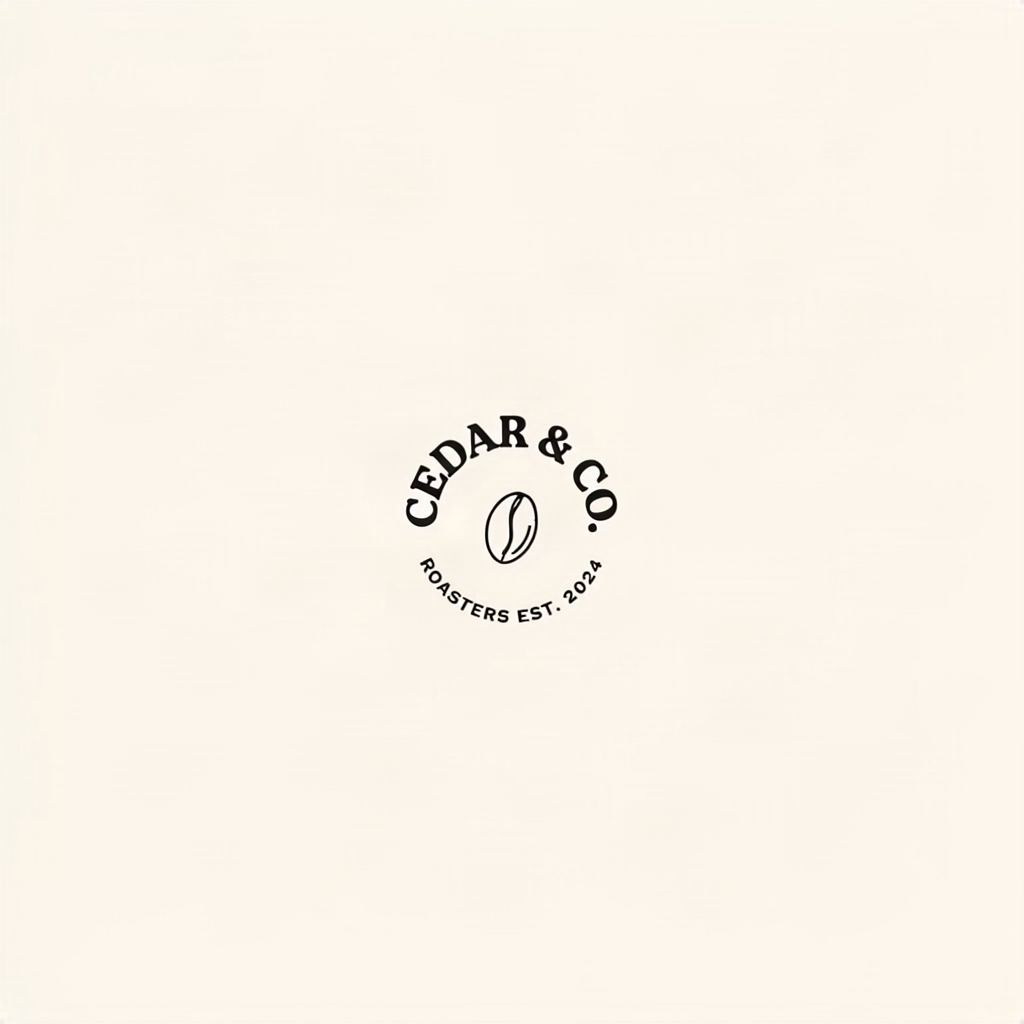
Image: A brand wordmark produced by ideogram-v4 at the BALANCED setting, suitable for logos or circular badge designs.
For Chinese-language scenarios, you should know a limitation in advance: Ideogram's strengths are concentrated in English typography. Although it can render Chinese text, its accuracy is not as good as for English. If the image is mainly Chinese text, the more reliable choice is the model below.
3. Qwen Image 2.0 Pro (hosted via HiAPI, for Chinese text scenarios)
This is the Chinese-language alternative suggestion given in Ideogram's own official FAQ, not just HiAPI's claim. qwen-image-2.0-pro also uses the unified /v1/tasks asynchronous interface on HiAPI, billed per image at $0.107/image. If Chinese signage, Chinese posters, and Chinese UI copy are the main image generation scenarios in your product, this is a more reliable path than forcing Ideogram to handle it.
Quick Comparison
| Dimension | HiAPI (Unified API) | Ideogram (Native) |
|---|---|---|
| English typography precision | Hosts the original ideogram-v4 model, same precision |
✅ Industry benchmark, original vendor advantage |
| Chinese typography | Can switch to specialized models like Qwen Image 2.0 Pro | Can render, but accuracy is lower than for English |
| Custom model training | Not provided (hosted inference, not a training platform) | ✅ Provides training interface |
| Multi-model aggregation calls | ✅ One key for all modalities: image/video/audio/LLM | ✅ Also aggregates some third-party models within its product |
| OpenAI-compatible integration | ✅ Chat Completions endpoint; migration only requires changing the base URL | Not provided |
| Billing method | Pay-as-you-go, no charge for failures, 200 credits on signup | Tiered per-image billing, no subscription required |
| Video generation | Video models all have developer APIs | Consumer web app only, no public developer API |
| Documentation language | Chinese and English documentation | Mainly English |
Two honest acknowledgments: custom model training is currently unique to Ideogram and is not provided by HiAPI; and multi-model aggregation calls are also being done within Ideogram's own product — this isn't a capability invented exclusively by HiAPI, it's just that HiAPI covers a larger number of modalities and models.
How to Choose
- Only doing English logos, posters, or signage and no other modalities needed: Use Ideogram's native product directly, or call
ideogram-v4via HiAPI — either works, with identical results. - The same product also needs video, background music, or an LLM for copywriting: Choose HiAPI, using one key to put typography images and other modalities into the same pipeline.
- Posters, signage, or UI mainly in Chinese text: Use Qwen Image 2.0 Pro or similar Chinese-optimized models on HiAPI; don't force Ideogram to render Chinese.
- Need to train a dedicated font or brand style model: Currently only Ideogram's own training interface can do this; HiAPI does not provide this layer.
- Want to use free credits to test the workflow before deciding: HiAPI gives 200 credits on signup; test the call chain and results first, then decide whether to switch long-term.
FAQ
Is HiAPI a replacement for Ideogram or a complement?
It depends on your scenario. If you only do English typography images, the results are equivalent, so it's a replacement; if you also need video, audio, or multi-model collaboration, HiAPI brings Ideogram's capabilities into a larger calling scope, so it's a complement.
Is calling ideogram-v4 via HiAPI the same as using Ideogram's official API directly?
It's the same model, with identical typography precision and parameter behavior. The difference is the integration method: HiAPI uses the unified /v1/tasks asynchronous task interface, sharing the same authentication and SDK with other models.
Which is cheaper?
Both charge per image or per tier, and specific numbers change over time. We recommend checking the HiAPI pricing page and Ideogram's official website respectively to confirm current prices; we won't hardcode comparison numbers here.
Which model should I choose for Chinese text rendering?
Prefer Chinese-optimized models like Qwen Image 2.0 Pro. This is the recommendation given in Ideogram's own official FAQ, rather than forcing Ideogram to render Chinese.
Can Ideogram do video?
Ideogram has a consumer web app for video generation, but currently no public developer API. If you need to call video generation via API, the various video models on HiAPI are a viable path.
Conclusion
Ideogram is genuinely trustworthy for English typography, and this article doesn't intend to deny that. But if your product needs to cover image, video, audio, and LLM under the same set of credentials, or if you want to conveniently use models that handle Chinese typography more reliably, HiAPI has brought ideogram-v4 itself into its unified API, so you don't have to choose between the two. Sign up for a free HiAPI key and test the typography results and integration experience for yourself.
Related Reading
Related articles
View all articles →-

Comparison
Recraft v4.1 Flash Text-to-Image Horizontal Comparison: Developer Model Selection and Migration Guide
Use the $0.01 per-image cost and pure text-to-image capability to judge whether it fits your image generation pipeline
-
Comparison
hailuo-2.3-fast/image-to-video Side-by-Side Comparison: How to Choose an Image-to-Video Model and Key Migration Points
-
Comparison
Seedream 5.0 Pro Image-to-Image Side-by-Side Comparison: Capabilities, Pricing, and Selection Guidance