
Camera Language Visual Notes: Shot Diagrams for Reference-Image-to-Video
Using a set of hand-drawn-style camera-movement reference diagrams as input, the reference-image-to-video (R2V) path of happyhorse-1.1 turns static camera-language diagrams into playable dynamic demonstration clips. The topic targets storyboard and previsualization scenarios: common camera movements such as dolly-in, dolly-out, pan, truck, follow, and orbit are first annotated on the image with movement directions and axes, and the model then generates short clips with real motion, used to explain shot intent to the team or as visual communication material before shooting. In terms of composition, the reference image plays the role of a "shot diagram": the frame is a clean top-down scene view with camera-movement arrows, and the model produces smooth displacement on that basis; the prompt describes the camera path and pacing in the reference order of [Image 1], outputting a 16:9, 1080p, 5-second clip that can be looped directly in documents and presentations. This model family supports multi-reference-image fusion and subject consistency, making it suitable for chaining multiple camera-movement variants of the same scene into a shot notebook; a single segment is capped at 15 seconds, and longer sequences need to be generated in segments and then stitched together.
Style Camera Movement · Storyboard · reference-to-video
Model HappyHorse 1.1
Reference inputs
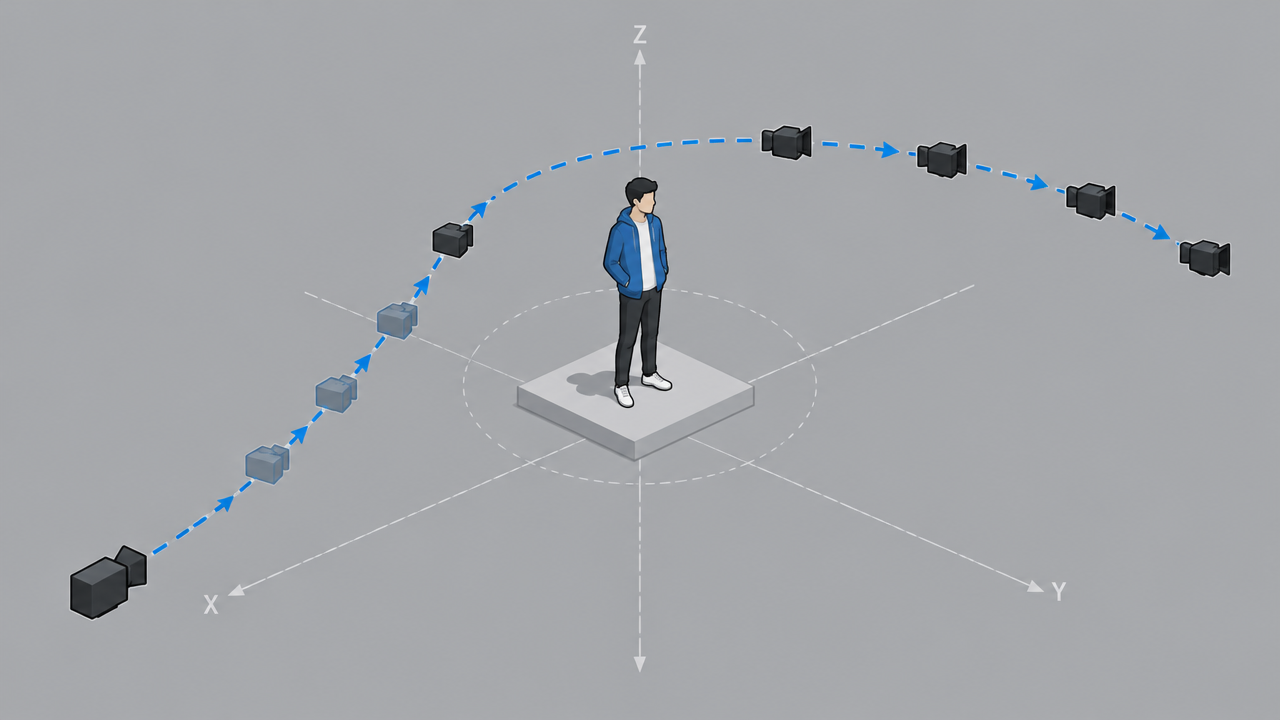
reference_image
Prompt
A cinematic camera-movement study shot: the camera starts on a static wide shot of the scene diagram, then slowly and smoothly dollies in along the axis annotated in reference image [Image 1], followed by a gentle lateral tracking move that keeps the subject centered in frame throughout. Steady lateral motion, consistent perspective, minimal camera shake, shallow depth of field with the main subject sharply in focus, soft directional daylight, soft neutral tones. Shot on a 35mm lens, 24fps look, temporal consistency maintained throughout, no text overlays, no cuts, a single continuous shot.
Copy the full prompt and adapt it for your own generation.
Tags