Meta
Muse Image 1.0
muse-image-1.0/text-to-image
Meta's reasoning-based image generation and editing model that first breaks down complex prompts before rendering, can fuse multiple reference images, and leverages web retrieval to ensure factual accuracy
Try muse-image-1.0/text-to-image
Input
Showcases
View all showcasesOutput
image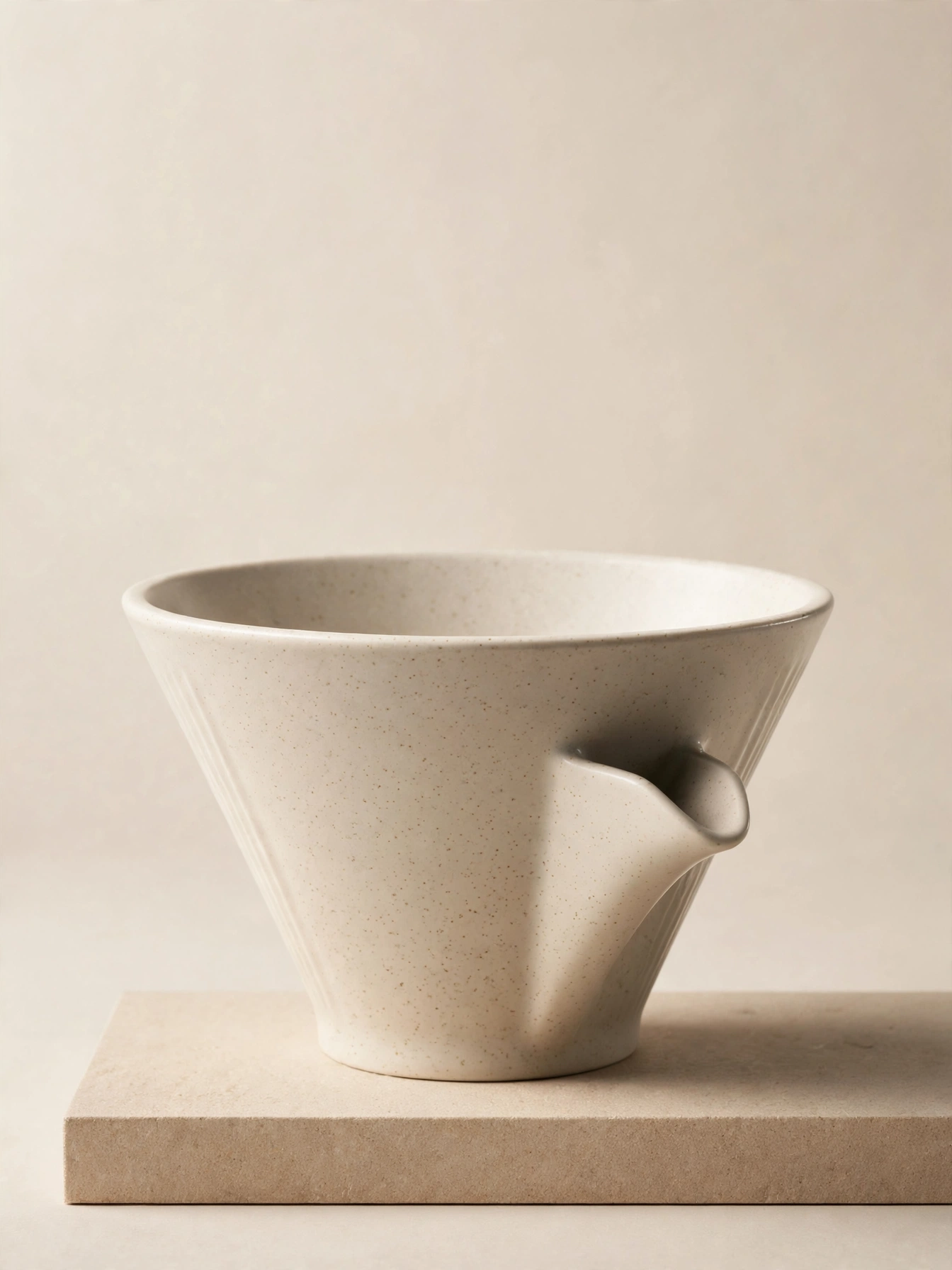
E-commerce-Grade Product Photography Quality: muse-image Text-to-Image Output
Style Product Image · Studio lighting · Business
Prompt
Studio product photo of a matte ceramic pour-over coffee dripper, warm white leaning beige, three-quarter view centered on a low sand-colored base. Seamless light beige background with soft gradient transition. Large softbox key light at 45 degrees from the upper left, a slight fill board on the right to lift the shadows, and a narrow strip rim light on the right edge to separate the subject from the background. Fine speckled texture visible on the glaze, round and crisp cup rim, geometrically precise spout. Shot with an equivalent 85mm lens at f/8, soft falloff at the far edge, no distortion. Clean commercial retouching aesthetic, neutral white balance, controlled highlights with no overexposure, soft contact shadow grounding the object. 4:3 portrait composition with ample negative space at the top for layout. No text, no logo, no cluttered props.
Copy the full prompt and adapt it for your own generation.
Tags
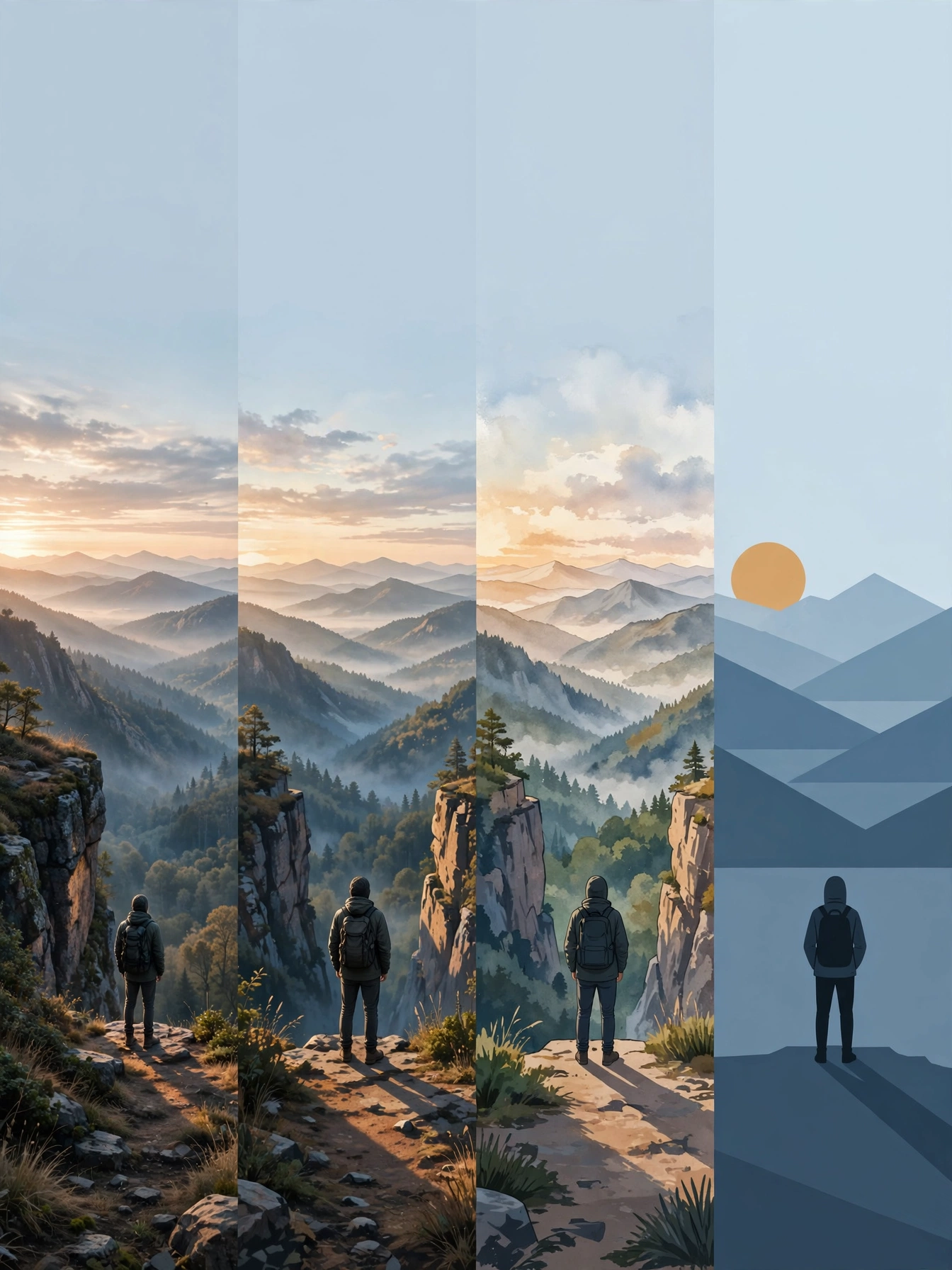
From Realism to Flat: A Spectrum of Illustration Styles
Style Illustration · Style Research · Art Direction
Prompt
An editorial-style single illustration subject, presented across a spectrum from realistic to flat style: a lone figure standing at the edge of a cliff, looking down over a layered valley at dawn. Composition: the subject is centered, anchored in the lower third of the frame, the valley recedes in horizontal bands toward a high distant horizon, and ample negative space is left in the sky above for typography. Style: a coherent illustration language with deliberately simplified stages—at one end photographic volume and atmospheric haze, at the other hard-edged vector color blocks with no gradients. Lighting: warm low-angle sunlight from the left, soft long shadows, cool ambient fill light in the valley. Palette: desaturated slate blue with warm ochre accents, limited and restrained color. Finish: crisp, sharp, print-ready artwork, clean silhouettes, no text or watermark.
Copy the full prompt and adapt it for your own generation.
Tags
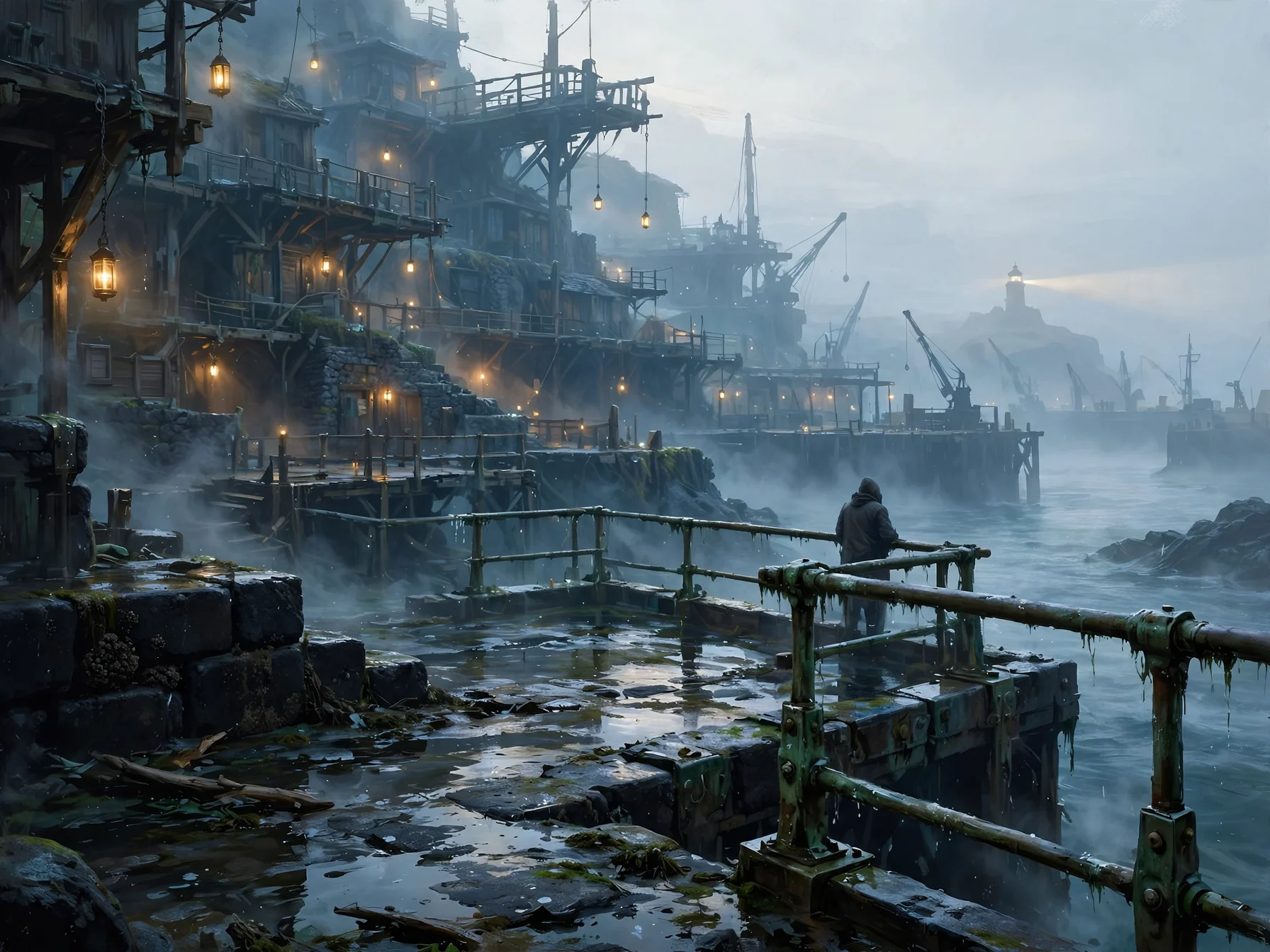
Worldbuilding Scene Concept Art: Fog Harbor Tide Observation Platform
Style Worldbuilding · Concept Art · Atmosphere
Prompt
A widescreen cinematic concept art piece depicting a mist-shrouded coastal harbor in a fictional world, 21:9 panoramic composition. Foreground: a tidal observation platform eroded by sea wind, constructed from dark basalt and oxidized brass, half exposed after the tide has receded, with the wet stone surface reflecting a pale sky. Midground: layered harbor buildings built along the cliffs, wooden boardwalks, hanging lanterns emitting warm amber light in the cold blue mist, and a lone figure in a heavy coat standing by the platform railing to convey scale. Background: the harbor mouth dissolving into layers of fog, silhouetted cranes and the beam of a distant lighthouse slowly sweeping across. Atmosphere: dense sea fog, drifting spray, low-contrast depth attenuation. Lighting: cool, overcast dawn, with only a single warm practical light source from the lanterns, soft volumetric light. Style: painterly digital concept art, restrained color palette—slate blue, oxidized teal, and muted amber, fine material detail on stone and metal, no text, no logos.
Copy the full prompt and adapt it for your own generation.
Tags
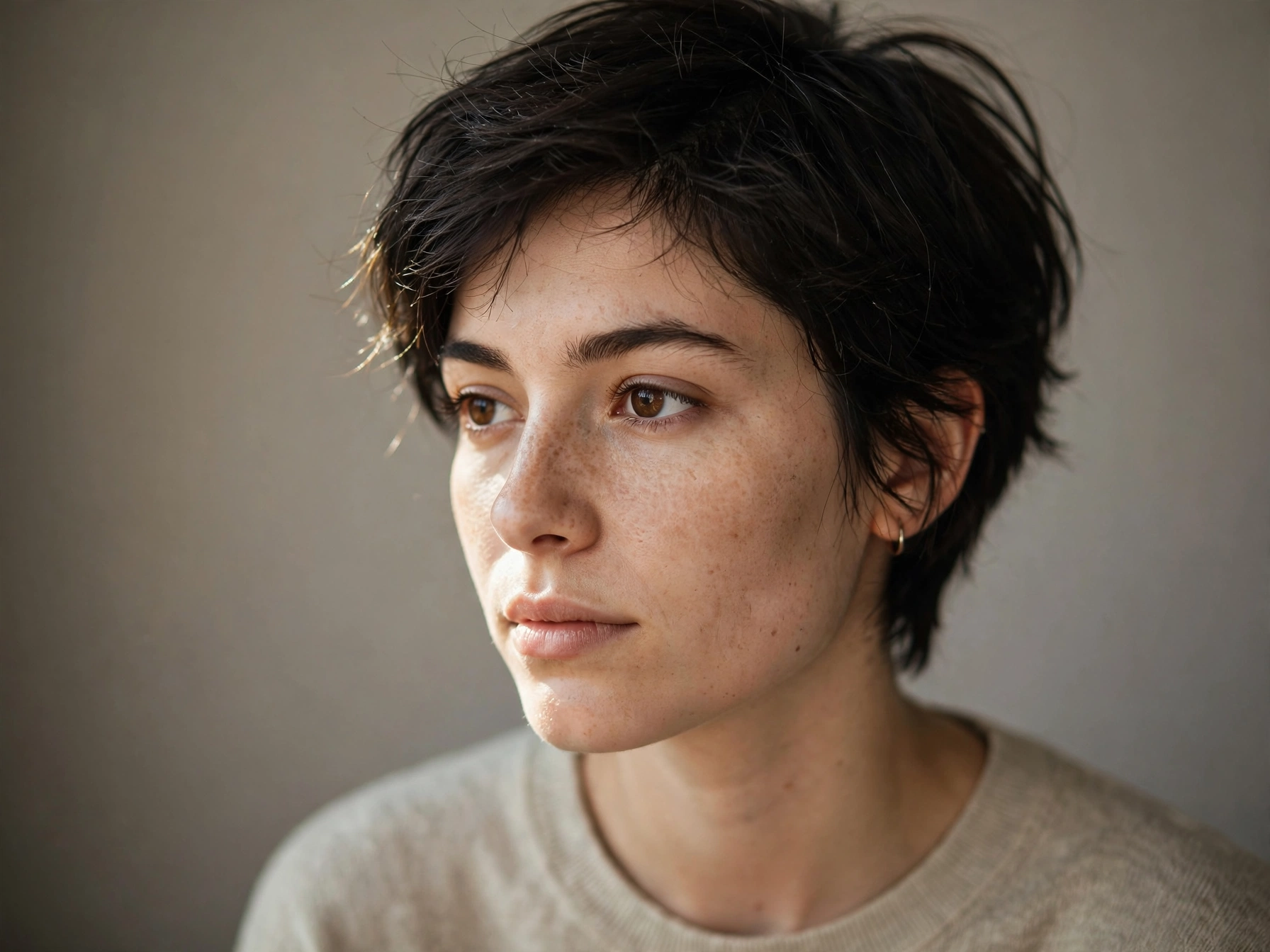
Muse Image 人像风格参考:真实感与艺术化的两种提示路径
Style Portrait & Photography · Photorealistic · Editing
Prompt
A 3:4 vertical studio portrait of a young woman with freckles and short dark hair, shoulders relaxed, gaze directed at but slightly off camera. A soft, broad key light from the left side of the camera creates subtle rim light on the hair, gently fading into a warm gray seamless background. Shot with an 85mm lens at f/2.0, shallow depth of field, realistic skin texture with visible pores and fine hairs, restrained color grading, no retouching. Overall editorial photography aesthetic, calm and grounded mood, rich facial detail, background deliberately kept simple to keep attention on the subject.
Copy the full prompt and adapt it for your own generation.
Tags
Pricing
muse-image-1.0/text-to-image per task
| Unit Price | $0.015 |
|---|
Overview
muse-image-1.0/text-to-image is the text-only route of Meta's text-to-image model on HiAPI.ai, using a generate-by-reasoning-then-rendering pipeline: before producing an image, it breaks down multi-part prompts, plans the image layout, and self-corrects during reasoning. It is suited to developers who need high-concurrency batch image generation with fairly complex prompts, such as ad creative variants and product catalog images. Called through the unified HiAPI.ai interface, it needs only a text prompt to generate an image, with selectable aspect ratio and output format.
Key Highlights
- Reason first, render later—complex prompts are more controllable—before rendering, it decomposes multi-part prompts, plans layout, and iteratively corrects the output in the reasoning chain, making it better suited to structured descriptions than single-pass forward generation.
- Knowledge-intensive prompts can use web retrieval—when a prompt requires real-world information, it calls web search to calibrate the content, reducing factual errors in accompanying images.
- One call outputs a finished image, easy to integrate—just submit a text prompt to specify the aspect ratio and jpeg, png, or webp output format, and directly obtain a deployable image asset.
Capabilities
Reasoning-based text-to-image: decomposes complex multi-part prompts into executable visual elements, plans layout before rendering, and self-corrects, reducing the cost of repeated prompt revisions.
Aspect ratio presets: offers nine ratios—1:1, 4:3, 3:4, 16:9, 9:16, 3:2, 2:3, 21:9, and 9:21—so you can select one directly for a placement or layout without post-cropping.
Multi-format output: supports jpeg, png, and webp download formats, with webp as the default, making it easy to choose according to frontend display, archiving, or downstream processing needs.
Long prompt support: prompts can be up to 5,000 characters, accommodating complex generation requirements with multiple paragraphs and constraint descriptions.
Use Cases
- Ad teams generating ad variants in batches—batch-generate images from multiple copy prompts for the same selling point, producing assets in different ratios for direct use in multi-channel ad testing.
- E-commerce operations creating product scene images—generate scene images in different styles and compositions from product description text to supplement product catalog and detail page visuals.
- Content teams illustrating knowledge-based topics—input topic descriptions containing factual elements to produce images that fit the content for articles, posts, and social media publishing.
Limitations and Selection Advice
Public materials do not disclose the output resolution of this route; aspect ratio determines only the proportions, not exact pixel dimensions, so scenarios with hard resolution requirements need prior verification. The reasoning-based pipeline and on-demand web retrieval add extra latency, making it unsuitable for real-time generation with very low latency. Output is limited to images and does not involve video or audio. If a task requires fusing or rewriting based on a reference image, use the image-to-image route in the same family.
Frequently asked questions
View all FAQs →-
How do I choose generation or editing?
Choose generation to start from a written brief, or editing with references to build on an existing subject or layout.
-
How many images can I get per task?
Each task returns one image with no count selector. Submit a new task with an adjusted prompt for another composition.
-
Can I select 1K, 2K or 4K?
This entry has no resolution tiers. Choose framing; the model determines dimensions, typically around 2.5MP. Inspect the downloaded file.
-
Which file formats can I choose?
Choose JPEG, PNG or WebP; the default is WebP. Select a format for your web or design workflow.
Create a generation task
https://api.hiapi.ai/v1/tasks Headers
AuthorizationstringRequiredAccount API key. Required on every request. Example: Bearer YOUR_HIAPI_API_KEY. Get your API key
Content-TypestringOptionalThe request body is always parsed as JSON; when sent, only application/json (optionally with charset) is accepted — any other value returns 415. Example: application/json.
Idempotency-KeystringOptionalIdempotency key, up to 255 bytes. Retries with the same key from the same account create the task only once; replays return the original taskId.
On network timeouts or client retries, the same key creates the task only once — no double charges (scope: the API key's account). Use a business-unique identifier as the key (e.g. "order-42"); replays return the original taskId, and keys expire 24 hours after the first request. See the Unified Async API overview for the full scenario matrix.
Body
modelstringRequiredCurrent fixed value: muse-image-1.0/text-to-image
routestringOptionalCurrent fixed value: default
inputobjectRequired
Business parameters for muse-image-1.0/text-to-image and route default — see the parameter table below.
promptstringRequiredminLength 1maxLength 5000Used to describe the image you want to generate, or to explain what should be modified and what should be preserved in the reference image, provided as a string.
aspect_ratiostringOptionalSelect the aspect ratio of the output image, provided as a string; this does not specify an exact pixel size.
1:14:33:416:99:163:22:321:9Show all (1)
9:21output_formatstringOptionalDefault: "webp"Select the file format for downloading the image, provided as a string; defaults to webp.
jpegpngwebpcallbackobjectOptional
Terminal-state notification config. When omitted, no callback is delivered — poll the task yourself. See the callback note below.
Provide callback.url when creating a task and HiAPI POSTs to your service once the task reaches a terminal state — no polling needed. The callback payload mirrors the task detail structure; signature verification, delivery retries and idempotency are documented on the Unified Async API overview page.
urlstringRequiredRequired when callback is present. A POST is sent to this URL once the task reaches a terminal state; must be a valid http(s) URL.
whenstringOptionalDefault: "final"Only final is supported today — notified on both success and fail.
finalstoragestringOptionalDefault: "temp"Artifact storage tier: temp (default, retained about 7 days) or persistent (long-term, billed by size). Insufficient balance or exceeding the storage cap silently downgrades to temp; the effective tier is shown in the task detail response.
temppersistentRequest examples
# Submit an async task; returns a taskId immediately (no waiting for generation)
curl -X POST "https://api.hiapi.ai/v1/tasks" \
  -H "Authorization: Bearer $HIAPI_API_KEY" \
  -H "Content-Type: application/json" \
  -d '{
  "model": "muse-image-1.0/text-to-image",
  "input": {
    "prompt": "…",
    "output_format": "webp"
  }
}'
const res = await fetch("https://api.hiapi.ai/v1/tasks", {
method: "POST",
headers: {
Authorization: `Bearer ${process.env.HIAPI_API_KEY}`,
"Content-Type": "application/json",
},
body: JSON.stringify({
model: "muse-image-1.0/text-to-image",
input: {
"prompt": "…",
"output_format": "webp"
}
}),
});
const task = await res.json();
// { code: 200, message: "success", data: { taskId } }import os, requests
res = requests.post(
"https://api.hiapi.ai/v1/tasks",
headers={"Authorization": f"Bearer {os.environ['HIAPI_API_KEY']}"},
json={
"model": "muse-image-1.0/text-to-image",
"input": {
"prompt": "…",
"output_format": "webp"
}
},
)
print(res.json()) # { code, message, data: { taskId } }200 OK
{
  "code": 200,
  "message": "success",
  "data": {
    "taskId": "tk-hiapi-01HZTQ8BX2N3GM3YFK4Z9D7VQR"
  }
}
400 Bad Request
{
  "code": 400,
  "message": "invalid request",
  "data": null,
  "error_code": "INVALID_REQUEST"
}
Get task detail
https://api.hiapi.ai/v1/tasks/:id Response fields
taskIdstringRequiredTask ID, always prefixed with tk-hiapi-.
modelstringRequiredResolved full model name. Tasks submitted with the route parameter return base@route (e.g. gpt-image-2/text-to-image@ext); otherwise identical to the name passed at creation.
routestringOptionalPresent only when the task was submitted with an explicit route parameter; echoes the submitted value.
statusstringRequiredTask status.
queued Queued, not started yet.
handling Being processed.
archiving Processing finished, artifacts being prepared.
success Terminal: completed, artifacts available (output returned).
fail Terminal: failed (error returned).
After submission, check status: success and fail are terminal, everything else is non-terminal. Poll every 1–3 seconds until terminal. On success, download artifacts from output[].url and transfer them before expireAt; pass storage: "persistent" at creation time when long-term retention is needed.
creatednumberRequiredTask creation time (Unix seconds).
completednumberRequiredUnix seconds when the task reached a terminal state; fixed to 0 while not terminal.
outputarrayOptional
Present only when status == success. Artifact list — always an array; a single task may return multiple types at once (e.g. video + first_frame).
Array [ object ]
Array items
urlstringRequiredArtifact URL, directly downloadable.
typestringRequiredCurrent possible values: video, image, audio, first_frame, last_frame, thumbnail; more may be added later.
expireAtnumberRequiredUnix seconds until which the artifact remains accessible; download or transfer before it expires.
errorobjectOptional
Present only when status == fail.
codestringRequiredBusiness error code.
messagestringRequiredError description.
Response examples
Success
{
  "code": 200,
  "message": "success",
  "data": {
    "taskId": "tk-hiapi-01HZTQ8BX2N3GM3YFK4Z9D7VQR",
    "model": "happyhorse-1-0",
    "status": "success",
    "created": 1777282033,
    "completed": 1777282099,
    "output": [
      {
        "url": "https://cdn.hiapi.ai/tasks/.../video.mp4",
        "type": "video",
        "expireAt": 1777886899
      }
    ]
  }
}
Processing (non-terminal)
{
  "code": 200,
  "message": "success",
  "data": {
    "taskId": "tk-hiapi-...",
    "model": "happyhorse-1-0",
    "status": "archiving",
    "created": 1777282033,
    "completed": 0
  }
}
Failed
{
  "code": 200,
  "message": "success",
  "data": {
    "taskId": "tk-hiapi-...",
    "model": "happyhorse-1-0",
    "status": "fail",
    "created": 1777282033,
    "completed": 1777282099,
    "error": {
      "code": "TASK_FAILED",
      "message": "task failed"
    }
  }
}Articles
View all articles →Related Models
View all models →Same Type
-
 GPT Image 2 OpenAI $0.007 /image
-
 Wan 2.7 Image Alibaba $0.035 /image
-
 Imagen 4 Google $0.030 /image
-
 Seedream 4.5 ByteDance $0.045 /image
-
 Grok Imagine Image 2.0 xAI $0.052 /image
-
 Grok Imagine xAI $0.011 /second
-
 Ideogram V4 Ideogram $0.050 /image
-
 Krea 2 Medium Turbo Krea $0.021 /image
-
 Nano Banana Google $0.021 /image
-
 Nano Banana Pro Google $0.057 /image
-
 FASHN Tryon v1.6 FASHN $0.107 /image
-
 FLUX.2 Klein 4B Black Forest Labs $0.0004 /image