
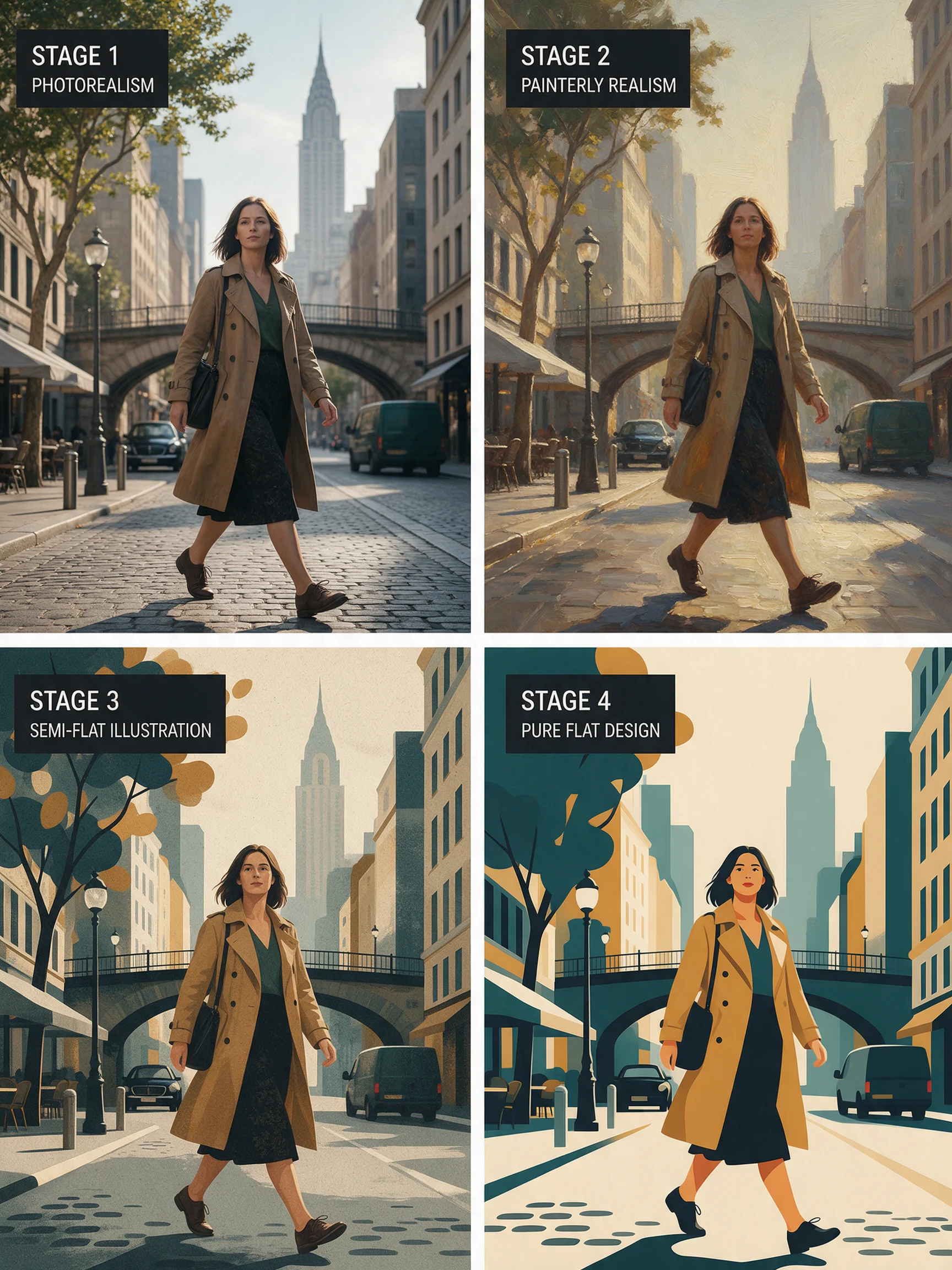
From Realistic to Flat: A Four-Level Comparison Across the Illustration Style Spectrum
Using the same subject description and the same model, this compares four levels of style intensity: realistic lighting and shadow, realistic with a painterly lean, semi-flat, and pure flat. The goal is to let developers directly see how "style words" in a prompt actually affect image structure, lighting layers, and color-block density — not just the color tone. Each image keeps the same compositional skeleton (foreground figure, midground street scene, distant skyline) and the same subject pose; only the style description paragraph changes, making side-by-side comparison easy. It works well as a comparison baseline for style transfer, for communicating visual direction to a design team, or as early style-exploration samples for an illustration project. This work was generated with Seedream 5.0 Pro (ByteDance text-to-image) on the author's pipeline, at 2K resolution in 3:2 landscape; the four levels from realistic to flat all hinge on reordering the words within a single prompt.
Style Illustration · Style Research · Flat design
Model Seedream 5.0
Prompt
A four-stage style spectrum study presented on the same composition: a foreground figure walking, a midground city street, a distant skyline. Stage one, photo-realistic: natural daylight, visible skin texture and fabric weave, true depth of field, subtle lens grain. Stage two, painterly realism: the same scene, but with visible brushstrokes, softened edges, warm reflected light, and slightly reduced color saturation. Stage three, semi-flat illustration: simplified volume, two-tone shading, crisp silhouettes, and a limited palette of soft teal, ochre, and cream. Stage four, pure flat design: geometric color blocks, no gradients, hard-edged shapes, and a bold flat palette. All stages keep a consistent composition and subject pose, 3:2 landscape framing, editorial art-direction reference quality.
Copy the full prompt and adapt it for your own generation.
Tags