
Comparison
gpt-image-2.6-sunburst/text-to-image Selection Guide: A Side-by-Side Comparison Based on Per-Image Pricing
From billing granularity and output form to integration cost, helping engineering teams decide whether to use it

On this page
What problem this model solves
Let's start with positioning. gpt-image-2.6-sunburst/text-to-image is provided by OpenAI; its output type is image, and its capability scope is exactly text-to-image: give it a text prompt and it returns an image. Its pricing is at per-image billing granularity.
It does not handle image-to-image, inpainting, multi-image editing, or image understanding—those are outside this article's scope. This article also does not restate the generic marketing language on the model card; instead, it answers three questions from an engineering team's perspective: how per-image billing affects the cost model, which dimensions to look at in a side-by-side comparison, and what it costs to switch from an existing model.
To summarize the applicability boundary in one sentence: if your business is standardized production of "prompt in, finished image out," and per-image cost can be extrapolated linearly from request volume, this model's shape fits; if you need controllable intermediate steps (for example, specifying sampling step counts or controlling resolution tiers for fine-grained cost tiering), first confirm whether those capabilities exist—do not assume they do.
For details such as parameters, context limits, and concurrency quotas, refer to the model detail page and API documentation; this article only makes judgments at the selection level.
The minimal contract for input and output
From an integration perspective, the contract for this type of API is very plain: the request body contains a prompt, possibly with optional fields such as size or count (see the docs), and the response contains the image result, which may be a binary stream or a URL with an expiration time. Confirm this contract clearly before selection, because it determines your subsequent storage strategy, retry strategy, and idempotency design.

What per-image billing means
The core characteristic of per-image billing is: the billing unit equals the number of successfully produced images, not tokens consumed, sampling steps, or GPU seconds. The known price is $0.023 per image; this article only does arithmetic at that granularity and does not extrapolate any unpublished pricing rules.
Cost formula
Cost per request = number of images requested × unit price. Monthly cost = monthly number of successfully generated images × unit price. This formula is so simple it seems hardly worth writing, but it has two engineering consequences.
First, cost is tightly bound to "the successful part of request count." If failed requests are not billed, cost is unaffected; if they are partially billed, you must distinguish that in logs. The first thing to do in engineering is to instrument three metrics separately—"requests initiated," "successful images generated," and "billed images"—rather than merging them into a single QPS view.
Second, retries directly translate into the risk of doubled cost. Any non-idempotent retry may produce duplicate images and duplicate billing. So retries must have a cap, must carry an idempotency key, and must be able to recognize the case where "the previous attempt actually succeeded, but the response timed out."
Retry overhead must be modeled separately
Suppose a business request triggers an average of r attempts (including the first). Then the effective cost on paper is amplified to roughly (1 + extra attempt rate) times. This coefficient is usually diluted for token-billed models because each call is cheap and the absolute increment from a failed retry is small; but under per-image billing, every image is a complete billing unit, and the absolute value amplified by retries is something you must write into the budget.
Difference from usage-based billing
Models billed by usage dimensions such as resolution, steps, or tokens have a finer-grained cost curve, but are harder to estimate: you must first know the distribution of typical requests to calculate an average. The advantage of per-image billing is predictability—when the business side says "we need to roll out 100,000 images this month," the budget can be calculated immediately. The disadvantage is lack of elasticity: you cannot push per-image cost down by lowering resolution, and the only cost-control levers left are "reduce the number of images produced" and "improve first-attempt success rate."
Protection against failures and quotas
Under per-image billing, quota exhaustion and rate-limit errors are more costly because real cost is embedded in their retry windows. It is recommended to set a concurrency cap on the client, set per-business-line quotas in image counts (not request counts), and degrade to cached results rather than continuing to hit the API when a quota approaches its limit.

Which dimensions to examine in a side-by-side comparison
Do not compare only model names and unit prices. The following set of dimensions does not depend on any specific parameters and can be moved directly into a review spreadsheet.
Output type and capability boundaries
First confirm the output form: pure image, image plus text description, or support for multi-image input. Then confirm the capability scope: only text-to-image, or also editing, inpainting, and outpainting. The narrower the capability, the more stable the API, but the more likely the business side's composite needs will require you to assemble them yourself. The advantage of a single text-to-image capability is clear responsibility—it is suited to being "one layer of capability" rather than "a product."
Invocation mode
Synchronous return, asynchronous tasks, and streaming return impose completely different requirements on client architecture. Synchronous APIs are the least hassle, but timeouts and long-tail failures are more obvious; asynchronous tasks require task polling and callbacks, with higher integration cost but more controllability. At selection time, ask: does my call stack already have task-polling infrastructure?
Billing granularity
This is the focus dimension of this article. Divide candidate models into two categories: billed per image/per call, and billed by usage dimensions. The former suits batch businesses with predictable costs; the latter suits scenarios with highly uneven request distributions and acceptable estimation error. Do not compare the two with the same cost model, or the conclusion will certainly be wrong.
Controllability requirements
Does the business require specified size tiers, style consistency, or reproducible random seeds? The stronger the controllability, the more API parameters, and the higher the migration cost. Conversely, if the business has low consistency requirements (for example, mass-producing content illustrations), a single-capability model is actually less trouble.
Latency sensitivity
Distinguish between "users waiting in the presence of the request" and "offline batch processing." The former is sensitive to tail latency and needs timeout degradation and fallback images; the latter can tolerate minute-level latency and is better suited to the asynchronous task form. The same model may score very differently in these two scenarios.
Vendor lock-in risk
Evaluate three things: whether the API protocol is standard, whether returned results can be migrated directly (URL or binary), and whether you can switch among multiple vendors through a unified entry point. The last point determines your future bargaining power and disaster-recovery capability, and is worth writing into architectural constraints at the selection stage.
Data and compliance
Retention policies for prompts and outputs, and responsibility for content moderation—these do not go into the cost table but can block launch. Asking clearly in advance is far cheaper than discovering one week before launch that the pipeline must be changed.

When it is more suitable
Combining the single text-to-image capability and the predictability of per-image billing, the judgment basis for the following scenarios is relatively clear.
Batch image generation
When the business side's requirement is "illustration production that scales linearly with content volume," the linear cost model of per-image billing fits best. You can produce a budget directly with "estimated image count × unit price," without first sampling the request distribution. This is its most concrete advantage over usage-based billing.
Prototype validation and canary experiments
At the stage of validating "whether image-and-text generation capability is actually worth building into the product," a model with a simple API and clear billing unit can compress the validation cycle to the shortest. The team does not need to first build a resolution-tier system, nor tune parameters to save money.
Low-cost mass production on the content side
For scenarios with low consistency requirements and acceptable re-runs on failure (list-page illustrations, first drafts of marketing materials, content-platform illustrations), per-image billing plus a retry cap is an acceptable cost structure.
Conversely, when you should not choose it
First, scenarios that require fine-grained tiered control of per-image cost. If the product requires "low-resolution previews go through the cheap channel, high-resolution finals go through the expensive channel" and the model itself does not expose such tiers, you can only downsample in post-processing and cannot capture the cost advantage.
Second, scenarios requiring image editing, inpainting, or multi-round iteration. A single text-to-image capability cannot cover them, and forced assembly will bring multi-round calls; under per-image billing, every round is a complete billing unit, and total cost will quickly exceed expectations.
Third, scenarios with strong requirements on output consistency, such as same-series assets requiring strictly uniform style. In this case, the controllability weight is higher than unit price, and solutions with stronger controllability should be prioritized.
Fourth, real-time scenarios with extreme latency sensitivity and no fallback. If degradation is impossible after a timeout, retries under per-image billing will amplify both latency and cost at the same time.
A simple judgment order
First ask "is the number of output images predictable," then ask "are editing-type capabilities needed," and finally ask "is strong consistency required." If any of the three questions lands on the negative side, expand the candidate list instead of forcing a choice.
Integration implementation and common pitfalls
The following is the minimal viable pipeline for text-to-image integration, independent of specific parameters, and can be applied directly.
Authentication and request construction
Keep keys on the server only, never on the client. In the request body, make prompt the only required field, and explicitly pass default values for all other fields to avoid hidden drift from changes in upstream default behavior. Generate a business-side idempotency key for each request and write it into logs and request headers (or metadata fields, per the docs); this is the foundation for safe retries later.
Timeouts, retries, and idempotency
for attempt in 1..max_attempts:
  resp = call_api(prompt, idempotency_key, timeout=T)
  if resp.ok: break
  if resp.status in (400, 401, 403): break   # non-retryable
  if resp.status == 429 or resp.status >= 500: sleep(backoff(attempt)); continue
There are three key points:
- A timeout is not a failure. After a timeout, first look up the result (if the API supports lookup by idempotency key or task ID), then decide whether to resend.
- Never retry 4xx, especially parameter errors and authentication failures; retrying only burns quota.
- The retry cap must be hard-coded, and under per-image billing there must be a cost alert for "this request has already been retried N times."
Result storage
Do not rely on returned temporary URLs for long. Immediately transfer results to your own object storage after receiving them, and record a mapping of "idempotency key → storage path → billed image count" in the business table. This mapping is the sole basis for later reconciliation.
Four common pitfalls
Pitfall 1: Treating a timeout as a failure and resending directly. Upstream has actually already produced and billed the image; resending it once turns it into the cost of two images.
Pitfall 2: No quota by image count. Limiting only QPS and not image count means a single batch task can blow through the monthly budget.
Pitfall 3: Prompt concatenation has no versioning. When image quality fluctuates, you cannot locate whether the prompt changed or the model changed, and rollback has no starting point. Put version numbers on prompt templates.
Pitfall 4: Stuffing a synchronous API into the user request path. Upstream jitter directly becomes page timeouts, with no way to degrade. Either use asynchronous tasks or add fallback images.
A prototype of a unified invocation layer
It is recommended to add a thin adapter layer between business code and the model API, abstracting at least three methods: generate(prompt, opts), poll(taskId), and estimateCost(n). The first two isolate protocol differences, and the third lets the business side see the estimated image-count cost before submitting a task, avoiding budget overruns.
Migration and canary switching considerations
When switching from an existing image model to gpt-image-2.6-sunburst/text-to-image, order matters more than speed.
Step 1: Shadow-traffic comparison
Do not switch real traffic at the start. Copy online requests and send them to the new model, storing results only without returning them to users. Compare and evaluate two things: whether image quality meets the business baseline, and the difference between effective per-image cost and the current solution. The retry strategy during the shadow stage must be exactly the same, otherwise the cost comparison is meaningless.
Step 2: Canary by business line
Choose the business line least sensitive to quality and with the smallest impact from failure, and gradually open up the proportion from a small amount. During the canary, focus on three metrics: first-attempt success rate, average number of attempts, and actual billed image count per thousand business requests. The third metric is the number this article most wants you to watch.
Step 3: Adjust quotas last
Only after the billed image count in canary is stable should you adjust quotas and budget line items. Adjusting quotas in advance will let abnormal retries during canary be masked by the budget, and problems will be exposed only at full rollout.
What to abstract during migration
- Capability abstraction: business code depends only on the semantics of "generate an image," not on a particular model's field names.
- Billing-caliber abstraction: each model adapter implements
estimateCost(n)itself, and upper layers always make budget judgments in "image count" rather than "money." - Error normalization: map various upstream error codes into a few unified categories (parameter error, rate limit, upstream failure, timeout), and retry strategies recognize only the normalized categories.
- Result-form normalization: regardless of whether upstream returns a URL or binary, normalize internally to "storage path."
Two points easily overlooked when switching
The first is prompt compatibility. Different models tolerate prompt length, language, and special symbols differently; before migration, run a batch of regressions with real prompt samples, especially templates containing Chinese and structured descriptions.
The second is the rollback path. During canary, there must be a one-click switch back to the old model, and the old model's quota must not be released immediately. Rollback is not failure; it is part of the design.
When doing multi-model switching under an aggregated entry point, the above abstraction layer can basically be reused directly, which is the main reason to write the "unified invocation layer" into architectural constraints.
A ready-to-use selection checklist
Go through item by item in the review meeting and archive after confirmation.
Requirements side
- The business only needs "text in, image out" and does not need editing, inpainting, or multi-image input.
- The number of images produced can be predicted from business volume, and a monthly image-count range can be given.
- The requirement for output consistency is low, or the business risk of inconsistency has been accepted.
- The path where users wait in the presence of the request already has fallback images or an asynchronous solution.
Cost side
- Budgeting is based on "successful images generated × unit price," not request count.
- The retry amplification coefficient has been written into the budget (estimated from average attempt count).
- Quotas are issued by image count, not by QPS.
- It has been confirmed whether failed requests are billed, and the three counts are distinguished in logs.
Engineering side
- The server holds the key; the client never touches it.
- Each request carries an idempotency key, and the idempotency key goes into logs and the result table.
- On timeout, do not resend directly; look up the result first.
- The retry cap is hard-coded, and 4xx is not retried.
- Results are transferred to your own storage and do not rely on temporary URLs.
- Prompt templates carry version numbers.
Migration side
- Shadow-traffic comparison is complete, with data on both quality and cost.
- Canary proceeds by business line, and the metric watched is billed image count per thousand requests.
- Quota adjustment is scheduled after canary stabilizes.
- A one-click rollback switch is retained, and the old model's quota is not released in advance.
Architecture side
- Business code does not depend on any specific model fields.
- The cost estimation API takes image count as input.
- Error codes have been normalized into four categories, and retry strategies recognize only normalized categories.
- Result forms are unified internally as storage paths.
If more than three lines in this checklist cannot be confirmed, it is recommended not to enter canary first; fill the gaps before proceeding. The essence of selection is not choosing a model with a lower unit price, but choosing a model that matches your cost model, retry model, and rollback model. Only after completing the checklist can you proceed to implementation; for subsequent parameter and version details, refer to the model detail page and API documentation.
Related articles
View all articles →-

Comparison
Gemini Omni 1.2 Flash Model Selection Checklist: Input Modes, Specs, and Budget
Verify input modes, specs, budget, and effect boundaries, and complete model selection validation with your own samples
-
Comparison
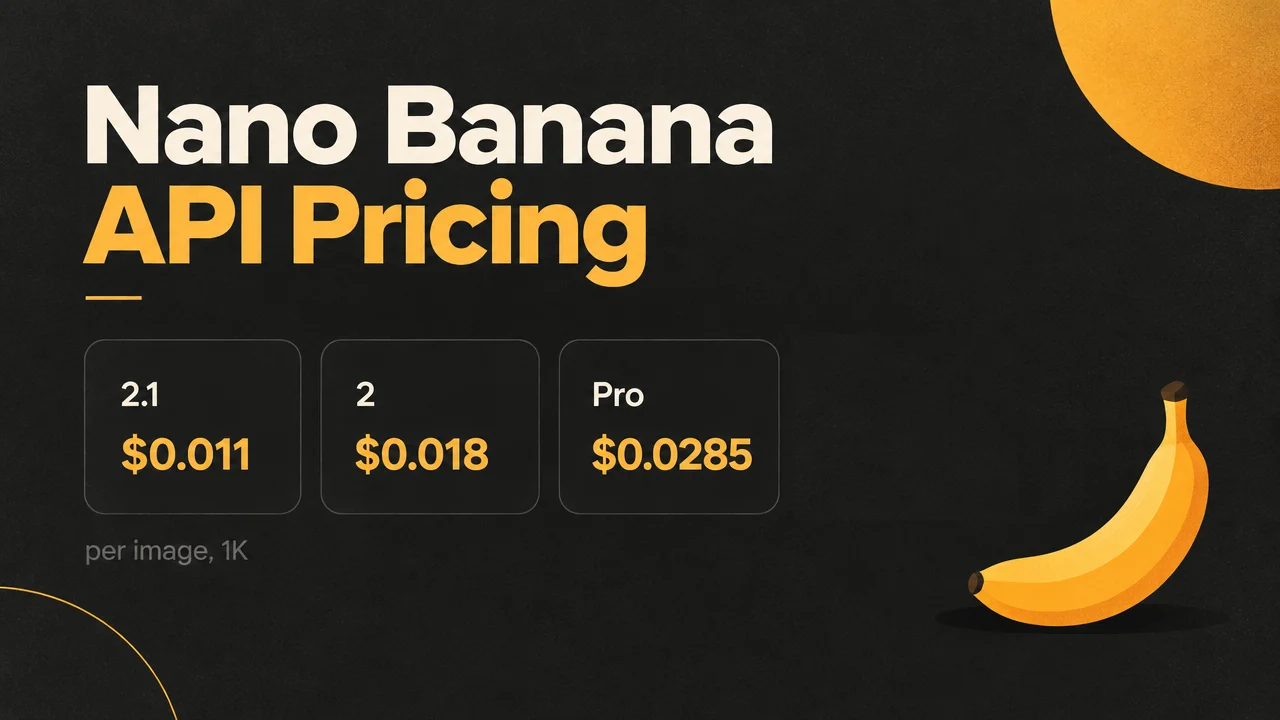
Nano Banana for Under 1¢ an Image: 2.1 vs 2 vs Pro, Same Prompt
List and Black Friday prices for 2.1, 2 and Pro, plus one prompt on all three
3 min read -
Comparison
AI Video API Black Friday 2026: Veo, Seedance, Kling Up to 23% Less
Per-second and per-clip prices for Veo 3.1, Seedance and Kling 3.0, at list and during Black Friday
3 min read