
Tutorial
Midjourney Practical Guide: 5 High-Value Application Scenarios from a Developer's Perspective

On this page
Why developers need to re-examine image models
Image generation has moved past the stage of "type a prompt and see what it draws." For developers, the question that truly matters has become: can it be stably embedded into existing business processes and become a link in the chain that can be invoked, monitored, and replaced?
This shift in perspective brings three concrete changes. First, the input and output of image models must be treated as structured data—where prompts come from, where results are stored, and how to retry on failure are all engineering problems rather than aesthetic ones. Second, calls incur costs, and especially under per-call billing, cost is linearly related to call volume, so the architecture must distinguish "trial-and-error calls" from "production calls." Third, generated results are not the endpoint; they must enter review, distribution, or downstream processing, and any missing link will block the entire chain.
This article uses the midjourney model on HiAPI.ai as an example. The model outputs images, supports both text-to-image and image-to-image capabilities, and is billed per call. Billing is per call, with three tiers by speed: relax $0.0644/per call, fast $0.0787/per call, turbo $0.1429/per call. This article does not dwell on the numbers; the focus is on "how to use it correctly and how to use it reliably."
The following content will first help you choose the right invocation method, then break down 5 actionable business scenarios one by one, and finally return to cost and acceptance—answering the most practical question: when can this move from trial to scale-up.

First distinguish the two invocation methods: text-to-image and image-to-image
Before you design any scenario, the first decision is not how to write the prompt, but which category this call belongs to.
Text-to-image takes plain text as input. Its advantage is high freedom, suitable for producing something "from nothing": a concept image that did not exist before, a mood image with no source material, or a batch of assets that need a consistent style but different content. Its uncertainty is also highest, because your control over the result depends entirely on the expressive power of the prompt.
Image-to-image takes a source image plus a prompt as input. It is suitable for "making variations on an existing foundation": style transfer on existing product images, visual refinement of existing sketches, or multi-version derivatives of existing assets. The key difference is that the source image itself is a strong constraint—it brings composition, subject, and proportion directly into the model, and the prompt only needs to describe "what it should become."
The rule of thumb for selection can be summarized as: If the business already has a "correct image," use image-to-image; if the business only has a sentence describing "what is wanted," use text-to-image.
There is also an easily overlooked boundary: the output quality of image-to-image is highly sensitive to source image quality. Low-resolution source images with unclear subjects and cluttered backgrounds will carry these defects into the results, and they are often harder to remedy through prompts than with text-to-image. Therefore, before incorporating image-to-image into a process, first confirm whether your source image assets themselves meet the standard.

Scenario 1: Batch production of marketing and operations assets
Marketing and operations is the scenario where image generation shows results most easily, because demand is high, iteration is frequent, and tolerance for "absolute perfection" is relatively high.
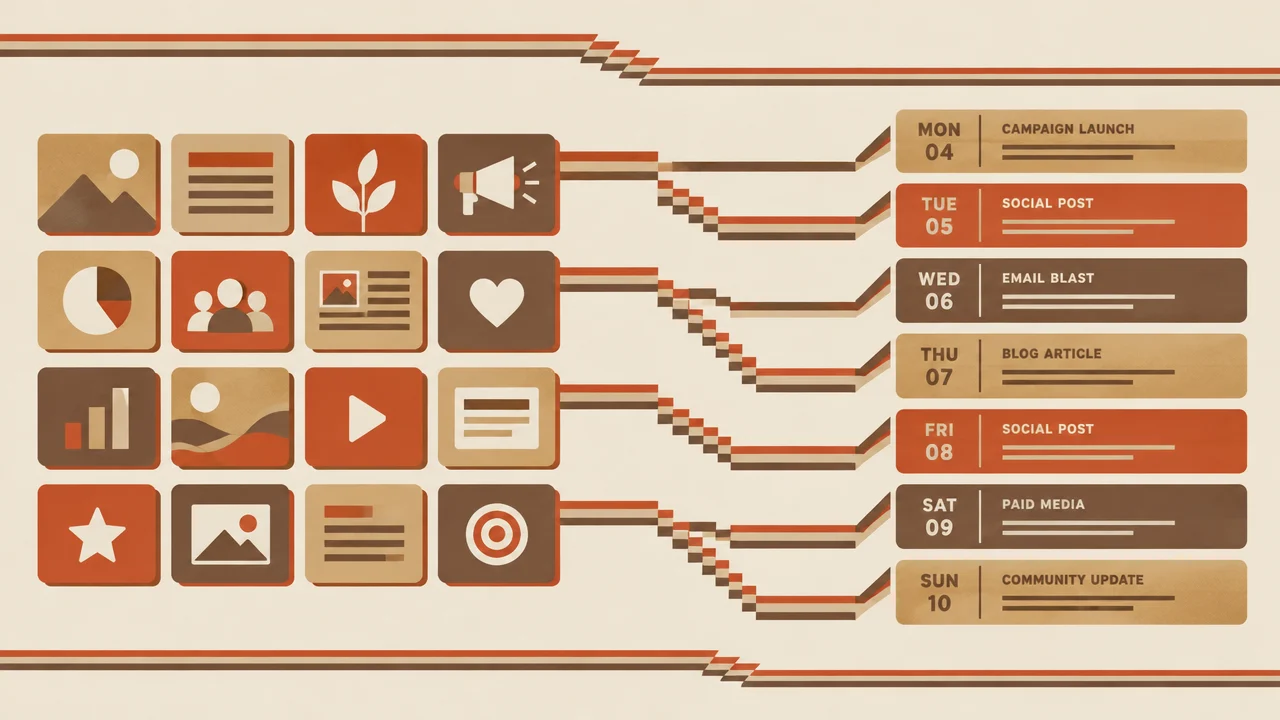
A typical use is batch-producing assets according to campaign rhythm: one campaign needs images in multiple sizes and styles; operations staff provide theme and tone descriptions, and engineering batch-generates candidates via text-to-image, which are then manually selected. The key here is not how stunning a single image is, but the production efficiency of the candidate pool—turning "finding images" into "selecting images."
Under batch invocation, there are three management points to think through in advance:
- Prompts should be templated. Brand tone, composition preferences, and prohibited elements should be distilled into reusable prompt fragments rather than having operations improvise each time. Only after templating can the style consistency of generated results be guaranteed.
- Calls should be traceable. Each batch task should record the task ID, prompt version, and call volume, so that when problems occur you can locate which batch and which prompt version caused them.
- Filtering should be front-loaded. If 20 images are generated and only 1 is kept, then the cost structure is "20 calls for 1 usable output." This ratio must be measured with actual samples before scale-up, because it directly determines the budget model.
It should be noted that marketing assets usually involve brand guidelines and compliance review. Generated results must be manually confirmed before formal publication; do not connect "automatic generation" and "automatic publishing" into an unattended chain.
Scenario 2: Style variants for e-commerce and product images
The product image scenario is the home turf of image-to-image. Merchants usually already have a qualified product photo; the need is not "draw a new one," but "change the visual presentation while keeping the product subject unchanged."
Common needs include: generating usage-scene atmospheres in different styles for the same product, adapting visual tones for different channels, and creating themed derivatives for seasonal or holiday moments. The common point of these needs is that the subject must remain faithful, and this is exactly the advantage of image-to-image over text-to-image—the source image locks in the product's appearance, and the prompt only needs to describe style and environment.
What needs the most attention during implementation is the quality threshold of input images. It is recommended to add a pre-check in the process: whether resolution meets the standard, whether the subject is complete, and whether the background is overly complex. Unqualified source images should be blocked before invocation rather than manually removed after generation—the latter amounts to paying call fees for input quality problems.
Another practical point is that the number of variants should be restrained. Deriving too many versions from the same product image increases downstream labor costs for selection and listing, and also dilutes the chance for each version to be seriously evaluated. Rather than generating a large batch, first validate in small batches whether the style direction is correct, then deepen the confirmed direction.
Scenario 3: Placeholder visuals in products and prototypes
The value of this scenario is often underestimated, but its improvement to R&D efficiency is very direct: the blank areas "awaiting images" in design drafts, demos, and demonstration environments have long been small friction points that block delivery.
The traditional approach is to wait for designer scheduling, or to make do with gray blocks plus text labels. After introducing an image model, text-to-image can quickly fill in placeholder visuals during the prototype stage, giving reviews and demos a version that "looks complete." The quality standard here is significantly lower than in production—the mission of a placeholder image is to convey layout and atmosphere, not to be a final deliverable.
For implementation, it is recommended to make this type of call into a lightweight tool rather than scattering it across projects: given a description and a set of sizes, return image URLs that can be inserted directly. The benefit of tooling is centralized invocation behavior, making it easier to count usage and to shut it down uniformly when not needed.
One boundary must be made clear: placeholder visuals must not flow into production environments. It is recommended to make explicit distinctions in asset naming or storage paths to prevent placeholder images from being mistakenly published as formal assets. Such incidents are not rare in small teams, and the cost of preventing them is extremely low.
Scenario 4: Image generation for content platforms and communities
When image capabilities are opened to end users or content creators, the complexity of the scenario rises another level, because the input changes from "prompts controllable inside the team" to "unpredictable user input."
There are usually two feasible paths: one is that the platform automatically generates images based on article content, without the user noticing; the other is to open generation capabilities to creators as a feature in the editor. The former is highly controllable; the latter offers a better experience but carries greater risk.
Whichever path is chosen, the review step must be front-loaded into the architecture, not added afterward. Specifically, this includes: blocking sensitive content on the user input side, compliance checks on the generated result side, and a clear degradation plan—when generation fails or is blocked, the content publishing process must not be interrupted, but should fall back to a default image or plain text display.
Degradation design should also cover failures on the model side: timeouts, abnormal returns, and results that fail quality standards all need clear fallback behavior. In consumer-facing scenarios, "this time it did not generate" is acceptable; "the user cannot publish content because generation failed" is not.
Scenario 5: The image step in internal tools and automated workflows
The last category of scenarios is not directly facing external users, but uses image generation as a step in an automated pipeline.
The typical form is: after a scheduled task or event is triggered, a batch of structured data is read (such as product information, article summaries, or report conclusions), assembled into prompts, used to call the model to generate images, and then the results are written into a shared asset library with records written back. The entire chain has no human intervention, so it has the highest requirements for interface stability and result traceability.
When designing such workflows, it is recommended to abstract the image call into an independent step rather than inline it in business logic. An independent step means it can be retried separately, monitored separately, and rate-limited separately. When a generation fails, only this step is retried, not the entire pipeline.
Result storage is also worth planning in advance. Generated images need a clear association with business entities (which image corresponds to which product, which article), and the prompts and parameters used during generation should be retained. Without this layer of metadata, the asset library will quickly become a pile of files with untraceable sources, making later style unification or quality tracing impossible.
Cost, acceptance, and rollout pace
Back to the principle mentioned at the beginning: per-call billing means cost is linearly related to call volume. The engineering implication of this sentence is that the enemy of cost is not unit price, but invalid calls.
Invalid calls have several common sources: overly aggressive retry policies causing repeated calls for the same need, poor prompt quality causing a large number of unusable results, and trial-and-error traffic mixed with production traffic so they cannot be distinguished. The corresponding control measures are also direct: set upper limits on retries and distinguish retryable from non-retryable errors; perform prompt iteration in an independent environment and converge with small-batch samples before entering production; tag calls with environment and purpose so that trial-and-error costs are visible.
For acceptance methods, it is recommended to abandon the practice of "judging generation quality by subjective feeling" and instead use small batches of concrete business samples for pre-validation. Specifically: extract a batch of representative inputs from concrete business (actual prompts, actual product images, actual articles), run one round of generation, and have colleagues who actually use these assets evaluate the usability rate according to business standards. This usability rate is the basis for deciding whether to scale up, and it also gives the most critical ratio in the billing model.
The rollout pace can be divided into two stages: the first stage is small-traffic canary release, focusing on whether usability and failure rates are stable; the second stage is scale-up with budget guardrails, which can take the form of usage-limit alerts or quota allocation by business line. Do not skip between the two stages, because problems exposed during the canary stage will be magnified dozens of times after scale-up.
To check model capabilities and billing details, you can go directly to the midjourney model page; integrating it into your first scenario will explain the problem better than continuing to evaluate.
Related articles
View all articles →-

Tutorial
Meshy-6 Text-to-3D in Practice: 5 High-Value Application Scenarios and Integration Essentials
-

Tutorial
meshy-6/image-to-3d in practice: 5 high-value use cases and key implementation points
From one image to a usable 3D asset: a cross-cutting view of cost, quality, and engineering integration
-

Tutorial
ltx-2.5-fast/audio-to-video in Practice: 5 Practical Audio-Driven Video Scenarios
A scenario-selection and implementation checklist for developers, from API integration to cost estimation