
Guide
Suno v6 Getting Started Guide: Capability Boundaries, Pricing, and Integration Practices for Text-to-Music

On this page
What Suno v6 Is: A Text-to-Music Audio Model
This model is billed per use, priced at $0.086 per use.
Suno v6 is a text-to-music audio generation model: the input is a text description, and the output is audio. It is not responsible for the business logic of writing lyrics, does not do mixing or mastering, and does not manage copyright for you. What it does can be summed up in one sentence—it converts a piece of textual intent into a playable audio result.
For developers, understanding this positioning matters more than memorizing any parameter. Its interface form is "one request → one generation → one audio artifact," so what you need to prepare for it in your system includes: a structured text input, a storage location that can hold audio files, and a mechanism for judging whether the result is usable. It is more like how an image generation model is used in engineering than like a text completion endpoint that can be called repeatedly at lower cost—every generation corresponds to one actual billing event.
If your scenario is "need a piece of music material whose style roughly matches the description," it is a suitable candidate; if your scenario is "need to make precise edits to an existing piece of audio," first confirm whether the model covers that type of capability, and do not assume it does.

Capability Boundaries: What It Can Do and What It Is Not Suitable For
Drawing the usable scope clearly first can save a great deal of rework later.
Suitable directions: generating music clips or complete sections from text descriptions; providing directional guidance by dimensions such as style, mood, rhythm, and instrumentation; quickly producing background music material for videos, podcasts, games, and presentations; batch auditioning and comparing multiple directions during early creative exploration.
Parts that need to be treated with caution:
- Precise control is limited. Text is the only (or main) control mechanism, and fine-grained requirements such as melodic direction, specific chord progressions, and bar-level arrangement usually cannot be hit reliably through prompts. Treat it as "directional guidance" rather than "precise arrangement."
- Results are stochastic. Calling multiple times with the same prompt does not necessarily yield the same result; this is normal for generative models. Any business process that depends on "getting it right the first time" must be redesigned.
- Outputs related to vocals and lyrics have usability affected by multiple factors such as language, pronunciation, and content compliance. Be sure to validate with a small sample before deployment, and do not schedule based on assumptions.
- Not suitable for situations requiring deterministic output, such as needs that must align strictly with an existing audio track or require reproducible audio fingerprints.
In one sentence: it excels at "generating music material that matches the atmosphere from scratch" and is not good at "precise modification and strict reproduction."
Must-Read Before Integration: API Parameters and Calling Points
When calling an audio generation model under the unified interface context of HiAPI.ai, the request side is usually organized around these types of elements:
- Prompt: the core input, describing style, mood, instruments, rhythm, and usage scenario. How it is written matters more than its length; see the prompt section below.
- Output type: this model outputs audio, and the caller must handle the response as an audio artifact rather than as text.
- Generation count and variants: if the interface supports returning multiple candidates at once, note that this directly multiplies the number of billing events. It can be enabled during evaluation and narrowed as needed in production.
- Timeout and asynchronous semantics: audio generation is not a millisecond-level operation. The client must set a reasonable timeout and make clear whether it is synchronous waiting or submit-then-poll/callback, avoiding putting long tasks into a synchronous HTTP chain.
- Error classification: handle "parameter error," "content rejected," "service busy/rate limited," and "generation failed" separately; only the last type is worth retrying.
The point most easily overlooked in engineering: the request body must be archivable. Store the complete prompt and parameters of each call in the database so that when results are unsatisfactory you can review whether the issue was the prompt or model randomness, and so that you can compare later when switching versions.

Pricing and Cost Estimation: How Per-Use Billing Works
Suno v6 uses per-use billing: billed per use, priced at $0.086 per use.
This billing basis makes the cost model very linear: total cost ≈ number of effective generations × unit price. So the focus of cost optimization is not "how to make one call cheaper" but "how to reduce unnecessary calls." Several common cost amplifiers:
- Unlimited retries. Failure retries, timeout retries, and users clicking retry repeatedly all multiply the number of calls. Retries must have a maximum count and backoff.
- Treating multiple candidates per call as the default. Enabling multiple candidates during evaluation is reasonable; in production it should be turned off unless necessary.
- Generating on every preview. Triggering a generation on every keystroke in the frontend is the most typical waste.
- No caching. The same or similar prompts are requested repeatedly without hitting any cache.
For estimation, roughly calculate as "daily active users × average effective generations per user × unit price," then add a 10%–30% margin for failures and retries. Once the numbers use a consistent basis, you can judge whether this model holds up in the business's revenue and expenses.
Typical Uses and Prompt Organization
Scenarios suitable for early deployment: background music for short videos/image-and-text content, podcast intros and outros, ambient sound for games and apps, emotional buildup for marketing materials, and batch comparison during the creative stage.
It is recommended to write prompts as "structured short phrases" rather than "prose-style long text." The following template can serve as a starting point:
Style: <genre/era feel, e.g. lo-fi hip hop / 80s synthwave>
Mood: <e.g. calm, uplifting, tense>
Instruments: <e.g. piano, soft drums, warm bass>
Rhythm: <e.g. slow tempo, steady beat>
Scenario: <e.g. background for product demo video>
Constraints: <e.g. instrumental only, no vocals; loopable>
A few practical rules:
- Turn fixed variables into templates. Extract style, mood, and scenario into configurable fields and maintain templates on the code side, avoiding result drift caused by hand-crafting prompts each time.
- Change only one variable at a time. When doing A/B tests, keep other fields unchanged so you can determine which word actually has an effect.
- Write "what you do not want" clearly. For example,
instrumental only,no vocalsare more effective than repeatedly describing "what you want." - Preset a prompt library for business scenarios. Turn a dozen or so common uses into named templates that callers reference by name, which both unifies quality and makes it easy to measure which template has a high hit rate.
Engineering Best Practices: Retries, Caching, and Quality Control
After integrating the model into a system, what determines total cost and experience is often not prompt technique but several engineering-layer matters:
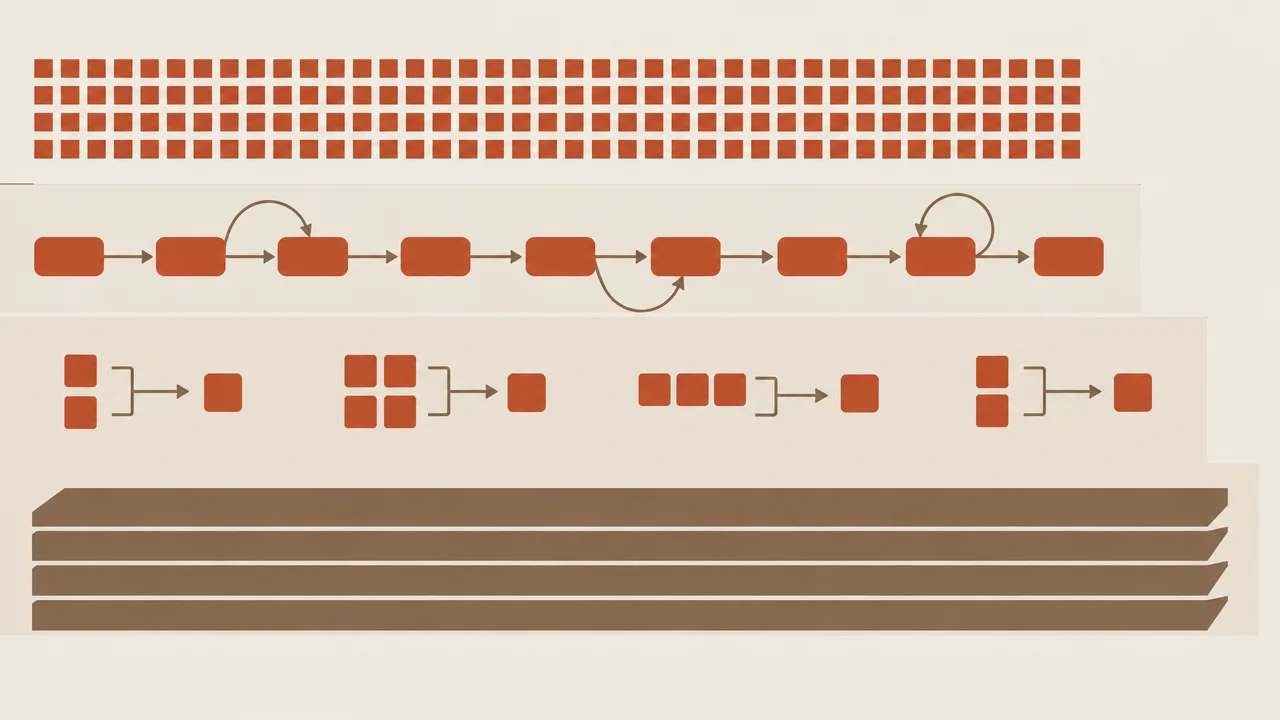
Layered design. The top layer is the prompt template layer (version-managed, with a record kept for each change); the middle is the request queue layer, responsible for concurrency control, rate limiting, timeouts, and backoff retries; the bottom is the result cache and storage layer, responsible for deduplication and archiving.
Retry strategy should be restrained. Retry only for "service busy/transient failure"; retrying parameter errors and content rejections is meaningless. Set a maximum number of attempts and record the consumption of each attempt so retry costs are visible.
Caching must be able to hit. Normalize the prompt (remove spaces, unify case, sort fields) and then compute a fingerprint; if it hits an already generated result, reuse it directly. For businesses where "the same batch of users shares the same set of templates," the hit rate is often higher than expected. The cache should store not only the audio address but also the generation parameters for traceability.
Move quality control earlier. Use a small set of fixed prompts as a regression set, run it every time a template is changed or a model version is switched, and evaluate the usable rate of results manually or by rules. After launch, monitor samples to avoid silent quality decline.
Observability. Instrument and record: call volume, failure rate, retry rate, cache hit rate, average generation time, and cost per effective output. Only by looking at these metrics together can you determine whether the problem lies in the model, the prompt, or the calling method.
Model Selection Advice and Next Steps
The recommended evaluation path for the team is: first use a dozen or so prompts close to the specific business to run a small-sample validation and confirm generation quality and scenario fit; then run a round of concurrency and failure-rate testing to estimate the actual cost range; and only then decide whether to scale up. Do not skip the first step and integrate directly; the cost of rework is far higher than one audition.
For detailed parameters and integration methods of the model, it is available on HiAPI.ai with per-use billing, priced at $0.086 per use.
Related articles
View all articles →-

Guide
meshy-6/image-to-3d Getting Started Guide: Capability Boundaries, API Parameters, and Pricing Practices
From image to 3D asset: what you need to understand before integrating a third-party image-to-3D model
-

Guide
Meshy-6 text-to-3d Getting Started Guide: Capability Boundaries, Pricing, and Integration Practices
From parameter design to cost control: integrate text-to-3D models into your workflow
-

Guide
LTX-2.5-Fast Text-to-Video Prompts: Copy-Paste Recipes for Developers
Reusable prompt patterns for storyboarding, native audio, and duration control
10 min read